Vulcan Capital Provides Seed to TriLinc for Global Impact Investments

LOS ANGELES – (BUSINESS WIRE) — Vulcan Capital, the multi-billion dollar investment arm of Vulcan Inc., has selected TriLinc Global Advisors (“TriLinc”) to seed the launch of the TriLinc Global Sustainable Income Fund (“TGSIF”). The investment is part of Vulcan Capital’s impact investing strategy.

Impact Investing is defined as investing with the specific objective to achieve a competitive financial return as well as creating positive, measurable impact in communities across the globe. 

TriLinc Global is an innovative impact investing fund sponsor with a mission to link market-rate returns, positive impact, and scalable solutions. Through its registered investment advisor subsidiaries, TriLinc has invested over $700 million in private debt globally and seeks to demonstrate the power of the capital markets in helping to solve some of the world’s pressing socioeconomic and environmental challenges. TriLinc funds provide growth-stage loans and trade finance to established small and medium enterprises (“SMEs”) in select developing economies where access to affordable capital is significantly limited. Borrower companies must demonstrate the ability to pay market rates, pass TriLinc’s environmental, social and governance (ESG) screens, and commit to tracking and reporting on self-identified impact metrics. 


“We believe that if something has the potential to do good, then we should do it.”


Founded by Microsoft co-founder and philanthropist Paul G. Allen, Vulcan Capital invests across all stages of corporate development including venture capital, growth equity and leveraged buyouts as well as investing in public equities and other liquid asset classes. Vulcan Capital’s current portfolio spans a range of industry sectors, including technology, internet, mobile, life sciences, energy, and natural resources, media and communications, and financial and information services. 

“Vulcan Capital is excited to be partnered with TriLinc Global in such a values aligned investment opportunity,” said Chris Orndorff, Chief Investment Officer of Vulcan Capital. “Vulcan strives to be at the cutting edge of impact investing, and we are proud to be partnered with TriLinc.” 

“TriLinc Global is honored to be partnering with Vulcan Capital,” said Gloria Nelund, Chairman and CEO of TriLinc Global, LLC. “Like Paul Allen and Vulcan, we believe that if something has the potential to do good, then we should do it, so we are thrilled to be working together with them to extend the impact of our investments in helping to solve some of the critical global issues facing our world today.”


About TriLinc Global, LLC

TriLinc Global is a private investment fund sponsor that empowers investors to use their private capital to make positive social impact at scale, without compromising return.  Through its registered investment advisor subsidiaries, TriLinc Advisors, LLC and TriLinc Global Advisors, LLC, TriLinc offers investors alternative investment products that pursue unique yield-oriented strategies while fostering the view that capitalism can be a force for good.  TriLinc believes in the power of the capital markets to solve social and environmental challenges and was founded on the conviction that impact investing not only rewards investors with attractive returns, it also has the power to change our world for the better.  For more information, please visit www.trilincglobal.com.


About Vulcan Capital

Vulcan Capital is the private investment arm of Vulcan Inc., the company founded by Paul G. Allen in 1986 to manage his business and philanthropic initiatives. Vulcan Capital is focused on generating long-term value appreciation across a multibillion dollar portfolio, which spans diverse industry sectors and investment asset classes, ranging from early-stage venture investments to public equity value investing, leveraged buyouts, acquisitions, and distressed situations.  


Contacts

TriLinc Global, LLC
Gloria Nelund, 310-220-0871
Chief Executive Officer 

Joan Trant, Managing Partner, Kicks Off UCLA Impact Week 2018

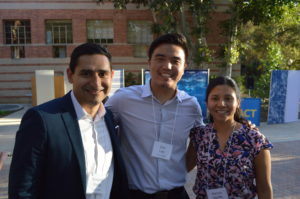
On April 9th, TriLinc Global Managing Partner, Joan Trant, kicked off Impact Week at UCLA Anderson School of Management with a fireside chat and engaging Q&A with students and program graduates. Joan covered topics on impact investing, Environmental, Social, and Governance (ESG), and impact measurement. TriLinc team members also participated in Networking Night following the fireside chat.

Impact Week is a collaboration between Impact@Anderson and the UCLA Anderson Net Impact Chapter. This year featured thought leaders and founders of mission-driven businesses and their powerful insights in the form of design workshops, panels, screenings, network mixers and more. ULCA Impact Week is a unique student-led event focused on finding the intersection of purpose and profit. Participating organizations included TriLinc Global, Patagonia, Morgan Stanley, BuzzFeed, Google, OpenIDEO, California Community Foundation, Sagewise, and CalSTRS.


Joan spoke about her career path first in international financial services in the Spanish, Mexican, and Argentine markets, and how that led to nonprofit development work in Latin America, then to global microfinance investment, and eventually to small and medium enterprise investment, given the sector’s catalytic effects on job creation and economic development.

“The world is an exciting, adventurous place where we all want the same things for ourselves and our families, but we don’t all have the same opportunities. TriLinc harnesses the power of capital markets to create the kind of world we want to live in.”

She also addressed the combined role of philanthropy and investment.

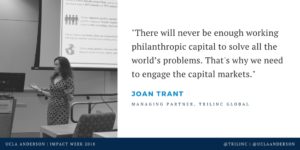
 “There will never be enough working philanthropic capital to solve all the world’s problems. That’s why we need to engage the capital markets.”


TriLinc Global is a private investment fund sponsor that empowers investors to use their private capital to make positive social impact at scale, without compromising return.  By intentionally pursing investments with the potential for market-rate returns and positive measurable impact, TriLinc helps investors do well by doing good.

To learn more about our global impact, click here.

The Global Impact Investing Network (GIIN) Presents: #GIINRoadmap

The Global Impact Investing Network (GIIN) released its Roadmap for the Future of Impact Investing: Reshaping Financial Markets. Commenced at the ten-year anniversary of the coining of the term impact investing, the Roadmap assesses industry progress to date, presents a vision for the financial markets, and outlines 18 specific actions needed to exponentially enhance the scale and effectiveness of impact investing across the world. The GIIN is the leading organization dedicated to increasing the scale and effectiveness of impact investing as well as transparency, credibility, and consistency in impact performance reporting.


TriLinc Global, LLC (“TriLinc”) is a founding member of the GIIN and actively supports the GIIN’s efforts to unlock significant private investment capital to help solve pressing global challenges.


“TriLinc is a founding member of the GIIN, and we have always shared the vision and dedication to improve the world through investing,” said Gloria Nelund, Founder and CEO at TriLinc Global, LLC. “Our management team are former senior executives of global banks and investment firms, with significant experience in impact investing. We are committed to contributing thought capital, as well as to providing investors with access to products that pursue market-rate returns alongside meaningful socioeconomic and environment impact.”

The Roadmap was developed with inputs from 350 individuals, including TriLinc’s Managing Partner, Joan Trant, who participated in the Senior-level Consultation to identify and refine the bold actions needed to integrate the broader financial markets into impact investing to achieve a better form of capitalism.

 “As a fund sponsor, at TriLinc it is our goal to harness the power of the capital markets to make a difference in communities across the globe,” said Joan Trant, Managing Partner at TriLinc . “We believe the pursuit of meaningful financial return and positive social and economic impact are mutually reinforcing, and industry research increasingly supports our position that a disciplined investment process that incorporates environmental, social, and governance screening and impact metrics can enhance risk-adjusted returns through identifying and mitigating potential risks.”

Learn more about this ambitious vision for transforming financial markets to create a world where social and environmental impact are routinely integrated into investment decisions. Find out how we can collectively take action to attain this vision here: https://roadmap.thegiin.org/

For more information about TriLinc’s impact investing philosophy, visit https://www.trilincglobal.com/impact/our-philosophy/. TriLinc Global is a founding member of the GIIN and its registered investment adviser subsidiaries actively use the GIIN’s Impact Reporting & Investment Standards (IRIS) to measure investments’ social, environmental, and financial performance. For more information about our reporting standards, visit https://www.trilincglobal.com/impact/reporting-standards/.

View TriLinc’s 2017 Sustainability and Impact Report here.


Podcast EP 1- Emerging Markets & The Impact Opportunity

The TriLinc Global Invest with Impact Podcast brings listeners insight and commentary from experts on the front lines of impact investing.

TriLinc Global is a private investment fund sponsor that empowers investors to use their private capital to make positive social impact, without compromising return. TriLinc believes in the power of the capital markets to solve social and environmental challenges. Listen and learn why.
 

In this Episode:
 

TriLinc Global Founder and CEO Gloria Nelund and CIO Paul Sanford join us in studio to discuss emerging markets and the impact opportunity. McKinsey estimates by 2025 consumption in emerging markets will reach $30 trillion annually. This represents what we believe to be the largest growth and impact opportunity in the history of capitalism. Listen and learn why Small and Medium Enterprises (SMEs) hold the potential to create tremendous sustainable social impact.

Click here to listen on iTunes.


DISCLAIMER

There is no guarantee that TriLinc’s investment strategy will be successful or will avoid losses. Investment in a pooled investment vehicle involves significant risk including but not limited to: units are restricted; no secondary market; limitation on liquidity; transfer and redemption of units; distributions made may not come from income and, if so will reduce the returns, are not guaranteed and are subject to board discretion. TriLinc is dependent upon its advisors and investment partners to select investments and conduct operations. TriLinc is not suitable for all investors. TriLinc Global LLC (“TLG”) is a holding company and an impact fund sponsor founded in 2008. TriLinc Advisors, LLC (“TLA”) is a majority-owned subsidiary of TLG, and TriLinc Global Advisors, LLC (“TLGA”) is a wholly-owned subsidiary of TLG. TLG and TLGA are SEC registered investment advisers. Unless otherwise noted, TLG, TLA and TLGA are collectively referred throughout this podcast as “TriLinc.”

Nothing in this podcast is to be construed as the rendering of personalized investment, legal or tax advice. Podcast content is for general purposes only and does not represent a recommendation or offer of any particular security, strategy, or investment.


TriLinc Global Honors International Women’s Day

TriLinc is pleased to honor and celebrate International Women’s Day today March 8th, and every day, through its fund-level and borrower company-level activities. We are proud to be a female-founded, female-led, and 51% Female owned firm.


According to a McKinsey study, if women play an identical role in labor markets to men’s, as much as $28 trillion could be added to global annual GDP in 2025 – a 26 percent increase. To raise awareness for gender equality, TriLinc tracks at the borrower level its portfolio companies’ female employment numbers and their policies and practices related to fair recruiting, maternal leave, and equality and empowerment.

At TriLinc we believe that better data on women business owners and employees will help governments establish more enabling policies, and assist the private sector in meeting women’s unique financing needs and workplace objectives. That’s why we focus on the UN Sustainability and Development Goals (SDG) number 5, Gender Equality, and SDG number 8, Decent Work and Economic Growth. We believe tracking borrower company data related to female ownership and employees, as well as policies such as Fair Hiring& Recruitment, Fair Career Advancement, Fair Compensation, Maternity and Paternity Leave, Child Care Support and Anti-Sexual Harassment, TriLinc seeks positive, measurable impact alongside market-rate financial returns to foster a more equitable society.

TriLinc’s mission promotes job creation through financing small and medium enterprises (SMEs), which are a proven engine for employment and GDP growth in select developing economies where access to capital is significantly limited. To raise awareness for gender equality, TriLinc tracks at the borrower level its portfolio companies’ female employment numbers and their policies and practices related to fair recruiting, maternal leave, and equality and empowerment.

Help us spread awareness for female-led and female-focused investments with #InvestWithHer on LinkedIn and Twitter.

Lean how TriLinc aligns with the UN SDGs, go to: https://www.trilincglobal.com/sustainable-development-goals-commentary/

For information on International Women’s Day, go to: https://www.internationalwomensday.com/

Gloria Nelund featured on Impact Mania

Original Article on Impact Mania


Gloria Nelund, Chairman & CEO of TriLinc Global, on Impact Investment

BY PAKSY PLACKIS-CHENG

Gloria Nelund cofounded TriLinc Global after serving as CEO of the U.S. Private Wealth Management Division at Deutsche Bank. TriLinc is set out to prove that profit and purpose go hand in hand.

Nelund retired at 44 and went into her “wilderness journey.” At one point she was a volunteer teacher for at-risk youth in the Los Angeles Unified School District. She spoke with impactmania about how one person, a man like her father, can impact thousands of people and how she decided to be in finance as a source of good.


How do you respond to market perception, where even professional investors are looking at impact investments and saying that they generate no or low financial returns?

It’s one of the reasons I started TriLinc Global. It was to prove to investors that they don’t have to give up the investment return to do good. If an impact investment is a real investment, then investment managers should be following the same investment discipline that they would for any investment in that asset class.

We believe that there are a number of funds that are impact funds that are probably not market rate. They focus more on promoting the impact. But we know there are a number of funds, including our own, that generate both a market rate return and positive impact. They’re not mutually exclusive, or they don’t need to be.

One of the things that we tried to do in the industry is work with other firms … to help define and promote the idea that investment discipline is just as important as measuring and monitoring and reporting the impact.

Could you provide an example of how you measure non-financial returns?

We ask all of our borrower companies to identify the impact that they intend to have. One of the requirements for getting money from us is that you have to be a good financial investment, and meet our investment criteria.

The second is that you have to be a sustainable company. They have to meet our environmental, social, and government screens, which really speaks more to the policies and practices of the company — how they run their company.

Then, third, we require them to have intent to create a positive measurable impact in their community. We let them self-identify what that impact is. Agriculture productivity is a positive impact that a company can have.

There are IRIS metrics [designed to measure the social, environmental, and financial performance of an investment] associated with agriculture productivity.

Once they’ve told us, for example, “We’d like to improve the energy efficiency of the farming practice,” then we go in and do a baseline assessment to say, “Okay, where are you today?”

Then we reassess. We then track, measure, monitor, and report out that impact to investors. We hold them accountable to achieving positive impact.


Are there certain industries that are better suited for impact than others?

We have seen impact across the board. We believe that any company, regardless of what they do, can have a positive impact in their community. It’s really more about their intent, and their ability to achieve that impact. The company doesn’t necessarily have to have a social mission to achieve great positive impact in a community.

We have a mine-remediation company in South Africa. Mine remediation itself may not be impactful. Their business model is that they’ll buy the land and they actually get the tailings; let’s say it’s precious metal. There are leftovers that aren’t worth mining, piles of dirt that have these things called tailings in them. This company has a process for extracting those tailings. Then they sell the tailings.

When they get through extracting all of the tailings, which is also cleaning up the land, they remediate the land, and in this case, they are donating it actually to a group that is going to build low-income houses.

Investors often say, “When I invest, I need to focus on maximizing financial returns. If I want to do good, I’ll just write a check and I’ll make a donation.” What is your response to that?

It’s interesting because I hear that all the time. Even when I was running Deutsche Bank’s Special Loans Management Department, it was surprising to me how even wealthy people separate those two thoughts in their mind. Basically everybody has two buckets. They have their investment bucket and their philanthropy bucket. Anything that they believe is concessionary — I’m not going to get the market return for that asset class — goes in their philanthropy bucket. It is very bifurcated.

High-net-worth investors typically with their whole portfolio are trying to maintain their lifestyle. Whereas retail investors in the U.S., they just want to make sure they don’t outlive their money. They can’t afford to lose any money.

A retail investor’s perspective is going to be even stronger as it relates to impact because if they believe that it’s concessionary, they can’t afford to do it. They really can’t afford to give up investment return. They might outlive their money. Retail investors typically haven’t had the opportunity, until recently.

With the trillions of dollars changing hands from one generation to another, are you seeing the next generation investing it more wisely?

This next generation of investors, because they really do care about changing the world, will get more behind it: number one because they care, but two, if we can really prove that there isn’t a trade off…

I sincerely believe that you don’t have to give up investment return to do it. Impact investments should target achieving a market return.

Our goal is to have more companies like ours who believe that it’s all about accountability and transparency and having the same discipline on the impact side that you have on the investment side. We hope to drive the industry towards that objective.

We believe we can get more people behind it even now.

You retired at age 44 from serving as the CEO of the Private Wealth Management Division at Deutsche Bank. Then you went into a couple of years of what you call “wilderness journey.” What advice do you have for people in this phase?

Take the time to experience that journey, find out what your calling is and what’s really important.

For me, through that journey, I realized that this really was my calling, It’s what I love and was really good at doing. It was about adapting the career that I loved in a way that also allowed me to have a positive impact.

I was personally missing that self-fulfillment of being, having some positive impact in the world and doing something good.

I went to volunteer for a number of organizations and realized, “Wow, this is not for me.” I so much more appreciated the people who do those things. I also realized it was harder on them having me there. I have passion about solving the problem. But I realized my contribution was supposed to come differently.

What did you learn from being a volunteer teacher of at-risk youth at the Los Angeles Unified School District?

Wow, I would say the biggest “aha!” came for me when I [realized] that we all can relate to each other on a very personal and emotional level, if we truly allow ourselves to be vulnerable and look for ways that we can relate as opposed to looking at how we’re different.

I probably learned as much in those years teaching these kids as I could have ever taught them. They have lives that none of us could even imagine. Yet they still need the same thought processes, problem-solving skills, encouragement, and ability to know how to act outside of their situation. They still need all that same stuff — or they’ll always be in it.

It was amazing; they’re just amazing people.

Who is one of your favorite impact makers — someone who left an imprint on your professional DNA?

Probably the person who got me really thinking a different way was Muhammad Yunus [a Bangladeshi social entrepreneur and banker who was awarded the Nobel Peace Prize for pioneering the concepts of microcredit and microfinance]. I got involved in microfinance, as it was getting a lot of notoriety back in the late ’90s. Yunus talked about using business as a force for good. … He spoke of people wanting to … take responsibility for their lives.

It all just made so much sense to me. I applied it differently. I didn’t do it in the microfinance space. It certainly was one of those things that got me thinking differently; realizing that you could use capitalism to solve problems, not just to make money.

Was it something you read, or did Yunus speak somewhere?

When I was at Deutsche Bank, he came and spoke to us. Deutsche Bank was very involved, early on at least, in our foundation. … It’s the first time I ever heard about microfinance really.

And directly from Yunus — that’s great.

Exactly. Then, I started researching it on my own. The Women’s World Banking Group did some events. Eventually, I was able to see it more in practice.

And then, this really did help shape me, even TriLinc: My father [Mac McMonagle] was a small businessman as I was growing up in my career. He started a number of businesses and grew them very successfully. I didn’t realize it until much later in my life that — watching my father and how he grew his businesses and how he treated employees, community members, suppliers, and customers — everybody was part of our family, and he was very ethical. When he would have a success, he would do something to give back to the community. As a result, whenever he started a new business, everybody supported him.

It was interesting because there was a time in my career when I was investing and I looked at it and was like, “Well of course; companies that do good things ultimately are going to perform better.”

Watching my dad and how he treated people certainly had a big impact on what I viewed as possible. It has shaped what we do at TriLinc.

He was a great person. He passed away a couple years ago; even then it was evident that just one person can have such an impact. We had thousands of people at the funeral.

What is one word that would describe your journey so far?

Let me think about that… interesting…

That’s the word?

That’s the word. It’s funny because the first word that came to mind was fun. I was surprised that that came to mind. I would say the majority of the time it’s fun.

I’ll take it: fun with some interesting in between.

Yes, fun with interesting in between. [Laughs.]


Prior to co-founding TriLinc, Gloria Nelund held fiduciary responsibility for more than $50 billion in investment assets. In addition to her role as divisional CEO, she served as the only female member of the Global Private Wealth Management Executive Committee.

Melissa Walker interviewed Monica Yunus. The daughter of Nobel Peace Prize winner Muhammad Yunus, one of Gloria Nelund’s impact makers.

What millennial investors want

The Millennial generation is set to receive the reins as the US undertakes the greatest generation-to-generation wealth transfer to date. The Millennial generation- those born between the early 1980s and the early 2000s- has a different take on the primary role of business compared to previous generations. As presented in the WEF report From the Margins to the Mainstream, “in a recent study of 5,000 Millennials across 18 countries, respondents ranked ‘to improve society’ as the number one priority of business [36% of survey respondents]. This does not imply that the next generation of investors will not seek market returns [35% of survey respondents]. However, the emerging generation of investors is likely to seek achievement of social objectives in addition to financial returns.”

The Millennial generation also has a larger propensity to donate time, money and work than previous generations. Here are some figures from the Millennial Impact Report conducted by Achieve:


The 75 million Millennials are positioned to become the wealthiest generation ever.


The research is clear: Millennials are generous but also very conscientious of whom and where their money is going. Millennials are understandably skeptical of the investments they make. In “Leading Generation Y,” Lieutenant Colonel Jill M. Newman of the United States Army argues, “The [Millennials] have witnessed more scamming, cheating lying and exploiting than ever before from major figures especially in finance in recent years.” The skeptical nature of this generation requires greater transparency on the part of financial sector organizations to attract this demographic.

Deloitte states that the 75 million Millennials are positioned to become the wealthiest generation ever, surpassing the 80 million Baby Boomers. “From the Margins to the Mainstreams” projects “over the next 40 years, an estimated US$ 41 trillion will be transferred” from Baby Boomers to their heirs, resulting in a powerful Millennial generation. The Millennials’ beliefs and values will be the drivers behind the world’s political, social, environmental and economic changes.

Impact Investing is turning out to be an appealing investment approach for Millennials due to its differing outcomes and operations than those of traditional investing. Impact Investing provides a new way of tackling the world’s most pressing issues while still providing an acceptable financial return. It also enables investors to place their money according to their values without having to forgo financial opportunities. While impact investments may currently represent a small portion of many adults’ portfolios, JP Morgan forecasts a drastic increase in these types of investments as money changes hands on a generational scale. They estimate that impact investing may expand from about $9 billion today to $1 trillion by 2020.

Many companies have sought out to democratize impact investing, in anticipation of the growing popularity. No longer are accredited investors the only investors offered a slice of the impact investing pie. With the introduction of new retail offerings, non-accredited investors, like many Millennials, have been given the opportunity to invest in corporations and businesses that share their values through impact investing.

This generous, yet monetarily wise generation will find ways to advocate for social and environmental missions, while still maintaining financial responsibility. Of course it’s only speculation, but it would seem that impact investing is an investment approach that is in line with Millennials. Demand creates supply. With this evidence the future for impact investing looks promising. Impact investing and Millennials go hand in hand.

Spotlight on Gloria Nelund, CEO of TriLinc

Gloria-Nelund

Gloria Nelund founded TriLinc after a rewarding career in the international asset management industry. She is responsible for leading the Company’s high level strategy and directing its growth since its founding in 2008. Gloria brings to TriLinc more than 30 years of experience in executive management of multi-billion dollar financial institutions, as well as deep expertise in the creation, sales and distribution of investment products.

Most recently, Gloria was the CEO of the U.S. Private Wealth Management Division at Deutsche Bank, the world’s fifth largest financial institution. In this capacity, she held fiduciary responsibility for more than $50 billion in investment assets, including more than $20 billion in emerging markets and credit instruments. In addition to her role as divisional CEO, Gloria served as the only female member of the Global Private Wealth Management Executive Committee.

Gloria has been a pioneer in the development of social impact products. She was instrumental in making Deutsche Bank a leading institutional supporter of microcredit, creating multiple programs to help Private Wealth Management clients learn about and invest in the sector. Gloria also served on the Board of the Deutsche Bank Americas Community Development Group, with responsibility for providing loans, investments and grants to targeted organizations throughout the U.S. and Latin America. Gloria also was the Managing Director of Scudder Kemper Investments prior to its purchase by Deutsche Bank. While at Scudder, she supported the development and growth of one of the industry’s first socially-responsible investment (SRI) products.

Prior to her tenure at Deutsche Bank, Gloria spent 16 years as an executive at Bank of America/Security Pacific Bank, most notably as President and CEO of BofA Capital Management, Inc., an investment management subsidiary managing $35 billion in assets for both retail and institutional investors. In addition to managing fixed-income and equity mutual funds in the U.S. and internationally, Gloria’s division was responsible for managing assets on behalf of public funds, common trust funds and corporate funds.

In addition to her activities with TriLinc, Gloria is an Independent Trustee of the Victory Funds, a mutual fund complex with more than $32.9 billion in assets under management. She is a life-long supporter of development-oriented philanthropic causes. She has volunteered as a teacher of at-risk youth in the Los Angeles Unified School District and the YMCA of Los Angeles. Gloria currently sits on the board of multiple not-for-profit organizations and actively supports entrepreneurship research and education. She is an active speaker and guest lecturer on Impact Investing at conferences and several top business schools, including Columbia, Georgetown, Wheaton, Kellogg, Stanford and MIT.

What is ESG?

ESG is a growing trend in the investment world, but only 1% of assets under management use ESG as a primary factor in investment considerations. What exactly does ESG mean and how are companies integrating this practice?

The acronym itself stands for Environmental, Social and Governance. Companies use ESG as a risk assessment strategy incorporated into both their investment decision-making and risk management processes. These factors are often clear indicators of a responsible, well-governed company. Examples of ESG are:


ENVIRONMENTAL

Company Activity:

  • Manage resources and prevent pollution
  • Reduce emissions and climate impact
  • Execute environmental reporting/disclosure

Positive Outcomes:

  • Avoid or minimize environmental liabilities
  • Lower costs and increase profitability through energy and other efficiencies
  • Reduce regulatory, litigation and reputational risk


SOCIAL

Company Activity:

  • Promote health and safety
  • Encourage labor-management relations
  • Protect human rights
  • Focus on product integrity

Positive Outcomes:

  • Increase productivity and morale
  • Reduce turnover and absenteeism
  • Improve brand loyalty


CORPORATE GOVERNANCE

Company Activity:

  • Increase diversity and accountability of the Board
  • Protect shareholders their rights
  • Report and disclose information

Positive Outcomes:

  • Align interests of shareowners and management
  • Avoid unpleasant financial surprises or “blow-ups”


ESG standards are becoming a larger part of the alternative investment world, including the impact investment space.  ESG issues are not only central to measuring the sustainability and non-financial impacts of an investment, but can have a material impact on the long-term risk and return profile of investment portfolios.

According to oekom’s Sustainability Financial Performance Research Study, investors receive a “double dividend” in the form of a better rate of return with lower risk. The study found that companies that incorporate ESG standards prove to be more conscientious, less risky and therefore more likely to succeed in the long run. Socially responsible investors use ESG screens as a tool to confirm that investments are in compliance with local laws, as well as committed to sustainable and ethical business practices.

Firms like Blackrock and Vanguard have not only incorporated ESG into their compliance and legal risk-mitigation strategies, but also into their investment strategies. Traditional investments like public equity, however, are not the only investments being screened with ESG factor. Investors in alternatives, and alternatives fund managers, are likewise using the ESG framework for assessing risk in the investment decision-making process.

The board of Wellington Management, an investment management firm based in Boston, explained their motivation for using ESG, “ ESG integration is simple: to increase financial returns while upholding the fiduciary duty to incorporate any known risks into the investment process.”

ESG standards provide another level of due diligence, which is in the best interest of shareholders. When the UN launched UNPRI in 2006 and watchdogs like Bloomberg and MSCI started tracking ESG, it became abundantly clear that this was not a short lived fad.

ESG weeds out unsustainable companies with outdated practices and harmful side effects, while also minimizing risk for investors as they invest in more responsible companies with a greater likelihood of succeeding in the long run.


porngameshub.netpornjoy.orgfistinghd.netxfaps.orgpornjav.org