Unique Business Model

Finding quality businesses to invest in requires deep local networks, a firm understanding of the culture and regulatory environment, and a local reputation for being a high-quality lending partner.


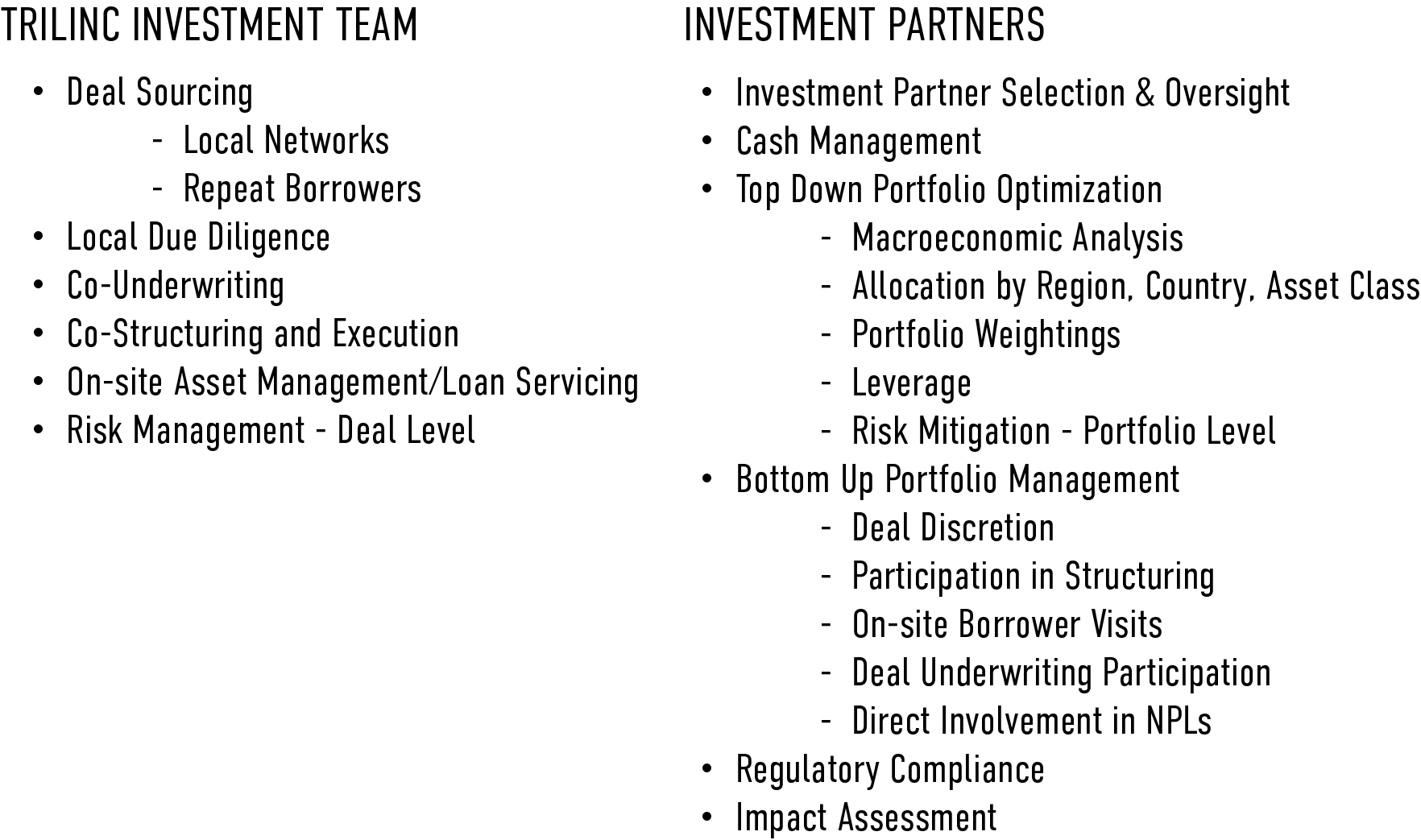
For these reasons, TriLinc has partnered with multiple experienced in-country private debt managers who act as on-the-ground agents, originating loans for TriLinc’s consideration and performing ongoing local investment level oversight.  In accordance with our risk management philosophy which emphasizes a comprehensive approach to investing and asset management, our investment partners strategies are primarily tailored to the characteristics of private financing of SMEs in developing economies.  In addition to the benefits of dual underwriting and global diversification, unlike a fund-of-funds model, there is a single layer of fees as management and incentive fees which are shared with investment partners.


Benefits of TriLinc’s Unique Partner Model

  • Boots on the ground to mitigate idiosyncratic local market risk
  • “Double” underwriting to ensure adherence to risk standards and specific client mandates
  • Emerging markets exposure without the volatility of public markets
  • Comprehensive diversification such that no single macroeconomic factor can significantly affect the portfolio
  • Flexibility to quickly adapt to changing local economic conditions


TriLinc’s investment strategy begins with “top-down” global macroeconomic analysis designed to identify countries with strong growth fundamentals, legal and political stability and unrestricted capital access.  The “top down” analysis is then complemented by “bottom-up” input from our local investment partners to identify markets with strong potential for financial returns and social and/or environmental impact.

TriLinc has implemented our investment strategy through partnering with multiple investment partners.


Private Debt Plus® Investment Strategy:

  • Targeting countries with favorable economic growth and investor protections;
  • Partnering with sub-advisors with significant experience in local markets;
  • Focusing on creditworthy lending targets who have at least 3-year operating histories and demonstrated cash flows, enabling loan repayment;
  • Making primarily debt investments, backed by collateral and borrower guarantees;
  • Employing sound due diligence and risk mitigation processes; and
  • Monitoring our portfolio on an ongoing basis.


OUR EXPERTISE

Although the shortage of capital available for SMEs is consistent throughout the developing world, the individual economics themselves are unique. Finding quality businesses to invest in requires deep local networks, a firm understanding of the local culture and regulatory environment, and a local reputation for being a high-quality lending partner. For these reasons, we believe the most prudent strategy is to complement top-down, macroeconomic portfolio optimization and management with experienced, local investment partners who have solid track records, and ample access to high-quality potential investments.

Investment partners are selected based upon a comprehensive due diligence process that evaluates their exposure to, skill with, and track record in select asset classes, regions and countries. Click here to read more. 

TGSIF Fund Closing Notice

On December 31, 2018, the TriLinc Global Sustainable Income Fund (“TGSIF”) closed the offering period to investors.

TriLinc plans to launch new funds in Q1 2019 in order to continue to provide investors with what we believe to be lower risk access to private investment opportunities available in select high-growth economies including Latin America, Southeast Asia, Sub-Saharan Africa, and Emerging Europe.

TriLinc’s private debt investment strategy (Private Debt Plus®) aims to deliver market-rate returns through private loans to private Small and Medium-sized Enterprises (SMEs) in select developing countries plus positive impact that is measurable and reportable utilizing the Global Impact Investing Network (GIIN) Impact Reporting and Investment Standards (IRIS).

For additional information, please contact info@trilincglobal.com


DISCLAIMER

This information is for general purposes only and does not represent a recommendation or offer of any particular security, strategy, or investment. There is no guarantee that TriLinc’s investment strategy will be successful or will avoid losses. Investment in a pooled investment vehicle involves significant risk including but not limited to: units are restricted; no secondary markets; limitation on liquidity; transfer and redemption of units’ distribution made may not come from income and if so will reduce the returns; are not guaranteed and are subject to board discretion. TriLinc is dependent upon its advisors and investment partners to select investments and conduct operations. TriLinc is not suitable for all investors. TriLinc Global LLC (“TLG”) is a holding company and an impact fund sponsor founded in 2008. TriLinc Advisors, LLC (“TLA”) is a majority-owned subsidiary of TLG and TriLinc Global Advisors LLC. (“TLGA”) is a wholly-owned subsidiary of TLG. TLG and TLGA are SEC registered investment advisors. Securities offered through Frontier Securities LLC, Member FINRA/SIPC. Registration and memberships do not indicate a certain level of skill, training or endorsement by the SEC, FINRA or SIPC.

Balancing Liquidity and Return Objectives Webinar Replay

On January 22, 2019, Gloria Nelund, Founder and CEO of TriLinc Global, and Paul Sanford, Chief Investment Officer, hosted an educational webinar – Balancing Liquidity and Return Objectives.

The webinar covered several topics, including:

  • What is Liquidity?
  • Liquidity and Returns
  • The Endowment Model and Liquidity
  • Rethinking Allocations


Click here to download a copy of the webinar deck.

Your Money’s Voice: Women & Investing Webinar Replay

On August 22nd, 2018 Gloria Nelund, Founder and CEO of TriLinc Global, and Sonya Dreizler, Founder of Solutions with Sonya, hosted an educational webinar – Your Money’s Voice – Women & Investing in 2018.

The webinar covered topics including:

  • How women are leading the way in impact investing
  • How to attract women investors
  • The tremendous growth of women as leaders in the workforce and in the boardroom
  • The importance of building a portfolio that incorporates your clients’ values
  • The opportunity in impact investing with women investors


Click here to download a copy of the webinar deck.

Developing Economies – A Significant Opportunity for Investment

Annual consumption in emerging markets is estimated to reach $30 trillion by 20251, representing what we believe to be the largest growth opportunity in the history of capitalism.


Developing economies have seen strong GDP growth over the last several decades fueled mostly by Small and Medium-Sized Enterprises (SME’s). Formal SME’s contribute up to 60% of total employment, and up to 40% of national income (GDP) in emerging economies1.

The World Bank estimates 600 million jobs will be needed in the next 15 years to absorb the growing global workforce, and in emerging markets, most formal jobs are generated by SMEs which create 4 out of 5 new positions.2 These SMEs, however, are underserved by the financial markets. The International Finance Corporation has estimated the unmet demand for SME financing in developing economies to be as much as $1.1 trillion dollars.3


The Opportunity with TriLinc

  • Track record of earning market rate returns
  • Positive Social and Economic Impact with Investments
  • Target select high-growth economies


TriLinc provides investors with what we believe to be lower risk access to private investment opportunities available in select high-growth economies. At present, we operate in four global regions: Latin America, Southeast Asia, Sub-Saharan Africa, and Emerging Europe. TriLinc only operates in countries with a stable political climate, reliable legal systems and growing economies. To view our Global Impact in these regions, click here.


How We Do It

TriLinc provides term loans and trade financing to private, expansion stage middle market enterprises in carefully selected developing economies where access to affordable capital is significantly limited. Since 2013 TriLinc has:

  • Invested over $1 billion in 36 countries4
  • Sustained zero default losses5
  • A five year track record
  • Provided investors with a fairly consistent yield, stable value and low correlation to public markets


If you are interested in learning more, please contact us.


1McKinsey & Company, Winning the $30 Trillion Decathlon, 2012 2The World Bank: Small and Medium Enterprises Finance, 2018 3Closing the Credit Gap for Formal and Informal MSME’s, International Finance Corporation, 2013, Washington DC, IFC 4Transactions, economies and financed amounts as of 11/30/18. These investments occurred in more than one investment vehicle, not of all which may be open for investment. 5To date, TriLinc has not realized any loan losses, however the value of some loans have been marked down from their original loan amount and in such cases may no longer be accruing interest.

Joan Trant, Managing Partner at TriLinc Global – The State of ESG & Impact Investing

Managing Partner Joan Trant discusses the new paradigm of incorporating ESG and impact investing as a risk mitigation portfolio strategy.

This interview was conducted at the Total Impact Philadelphia conference in April 2018. To learn more, visit their website at http://totalimpactconference.com/.

Read more about Joan’s participation in this conference here.

Impact Investing – Is It Possible to Have Your Cake and Eat It, Too?

Posted by Steve Distante on 5/31/18 10:39 AM

To view the original article, click here.


Is it actually possible to create investments that offer impact while at the same time returning market-rate financial returns? We interviewed Gloria Nelund of TriLinc Global, an investment sponsor with the mission of doing exactly that.

Vanderbilt: What do you see as the #1 reason you’ve been able to perform as well as you’ve been able to, creating market return as well as generating social impact?

Gloria Nelund:  We designed our investment strategy to take advantage of a real investment opportunity that also has the potential to create positive impact, and then we created rigorous processes, not only around our investment analysis but also around our ESG and Impact analysis.  What makes us different from other investment firms is that we embedded the ESG and impact tracking into our investment process.

For example, the analysis we do around a company’s ESG policies and practices is gathered in the beginning of our review, at the same time we’re doing our financial analysis of the company.  Our impact and sustainability analysts are part of the investment team and sit next to our credit analysts. When we first get an opportunity they’re together doing the analysis, yet they come at it from two different angles. One important thing about this process is that, early on in the deal analysis, we can identify any potential ESG issues that need to be considered before we commit to full due diligence.

We also are a bit unique in that we have impact objectives at both the portfolio level and the individual borrower-company level.  Our portfolio level impact objective on our current funds is Economic Development through providing access to capital to underserved SMEs in select developing economies.  That objective is tracked on all investments in the portfolio by measuring progress on five key metrics that are known to drive economic development (e.g. job creation).  Additionally, intent to create impact is something we look for in our portfolio companies, so, we require each borrower to identify their own impact objective(s) on which they are willing to be measured.

So, you can see that how we look at companies is multidimensional and goes past the traditional sort of pure investment analysis.

Vanderbilt: Do you think that the upcoming generations are truly more open to impact investing than their predecessors or does it seem more of a myth?

Gloria Nelund: Yes, I believe it is real.

I see it in my own kids, my nieces, nephews and their friends, and they’re all looking for investments that create some kind of impact. Right now, because they don’t have a lot of money, they’re looking at SRI and ESG-screened mutual funds, but, their desire to make a difference even shows up in the products they buy, the universities they consider, and the jobs they seek.

I truly believe it’s just a matter of time until we see the younger generations, the Millennials and Generation X, making more impact investments.  They’re just not at the stage in life yet where they have the wealth, but as they inherit or create wealth for themselves they will continue to drive demand.

We’re already seeing a catalyst with institutional investors though. They are starting to pay more attention to impact investing because there are now funds that can meet their institutional standards of quality investments with track records and rigorous processes. For example, our firm’s strategy now has a 5 year track record and almost $500MM under management so we are able to attract the institutional investors that we could never have as a startup.   It’s happening across the board as more and more fund managers are building the necessary track records and can finally be seen as a viable option for institutional investors.

Vanderbilt: What do you see as the biggest factor working against the progress of impact investing?

Gloria Nelund: There are a few things.

One is the lack of clarity from the industry itself around common definitions, language, and metrics.  I would say that, as an industry, we’ve made the biggest strides with ESG because the CFA Institute published an ESG Guide for Investors and have incorporated ESG principles into their CFA testing. That has really helped bring some clarity and emphasis.  But in other cases, the vocabulary can be quite varied. For example, we don’t all define “impact investing” the same way and we use different rules and standards for how we track and report.  The best illustration of this is “job creation.”  To measure growth in jobs, you need to know what defines a “job.” Is it only full time workers, or does it include part time workers, seasonal employees, contractors?

To make sure we are comparing apples to apples, there need to be commonly accepted rules and standards, similar to GAAP, the Generally Accepted Accounting Principles for financial reporting.  Just like companies in different industries have different types of financial reports, GAAP ensures that they all use the same definitions and apply common accounting rules the same way.  We need similar rules and standards that guide impact tracking and reporting, regardless of a firm’s individual impact framework.  For tracking and reporting on impact, our company uses the IRIS metrics, that then roll up to our impact objectives.

Second, education of advisors and investors is an issue. This is just a matter of time and scale; the more people who are aware of impact investing, and the more capacity there is, the quicker the adoption rate.

Third, there are still not enough investible funds that create competitive returns and impact at the same time.  Since the majority of investors simply can’t give up investment returns to do good, we need more impact investment options that can deliver market-rate returns.  Individual investors have two “buckets;” their investment bucket and their philanthropy bucket.  The investment bucket needs to generate their target returns so that they don’t outlive their money (or so they can maintain their lifestyle).  That means that anything perceived to have concessionary returns, ends up in the philanthropy bucket, which is a much smaller bucket.  So, if we want them to use “investment” capital, we need products that can do both; generate market rate returns from investments in sustainable, responsible companies, AND prove the impact of the investments.

Institutional investors have the same issue, but for different reasons.  They all have an investment mandate, or investment policy statement, that says “here is what you have to do.” So, they really can’t make concessionary investments either.

Impact investing, if done properly, can yield products that are scalable, deliver risk-adjusted market rate returns, with disciplined operations and compliance processes, yet at the same time, can generate positive, measurable impact. What Gloria didn’t tell us in the interview is that TriLinc Global is a B Corp, meaning they were required to undergo a rigorous certification process to demonstrate that the firm has great employee practices, great governance, is active in the community, and does appropriate things to support the environment. TriLinc Global is a great example of how we can be smart investors and business owners and do it all in a way that benefits people and planet.


Read more from the Vanderbilt Financial Group blog here.

TriLinc Takes Center Stage at EMPEA Conference

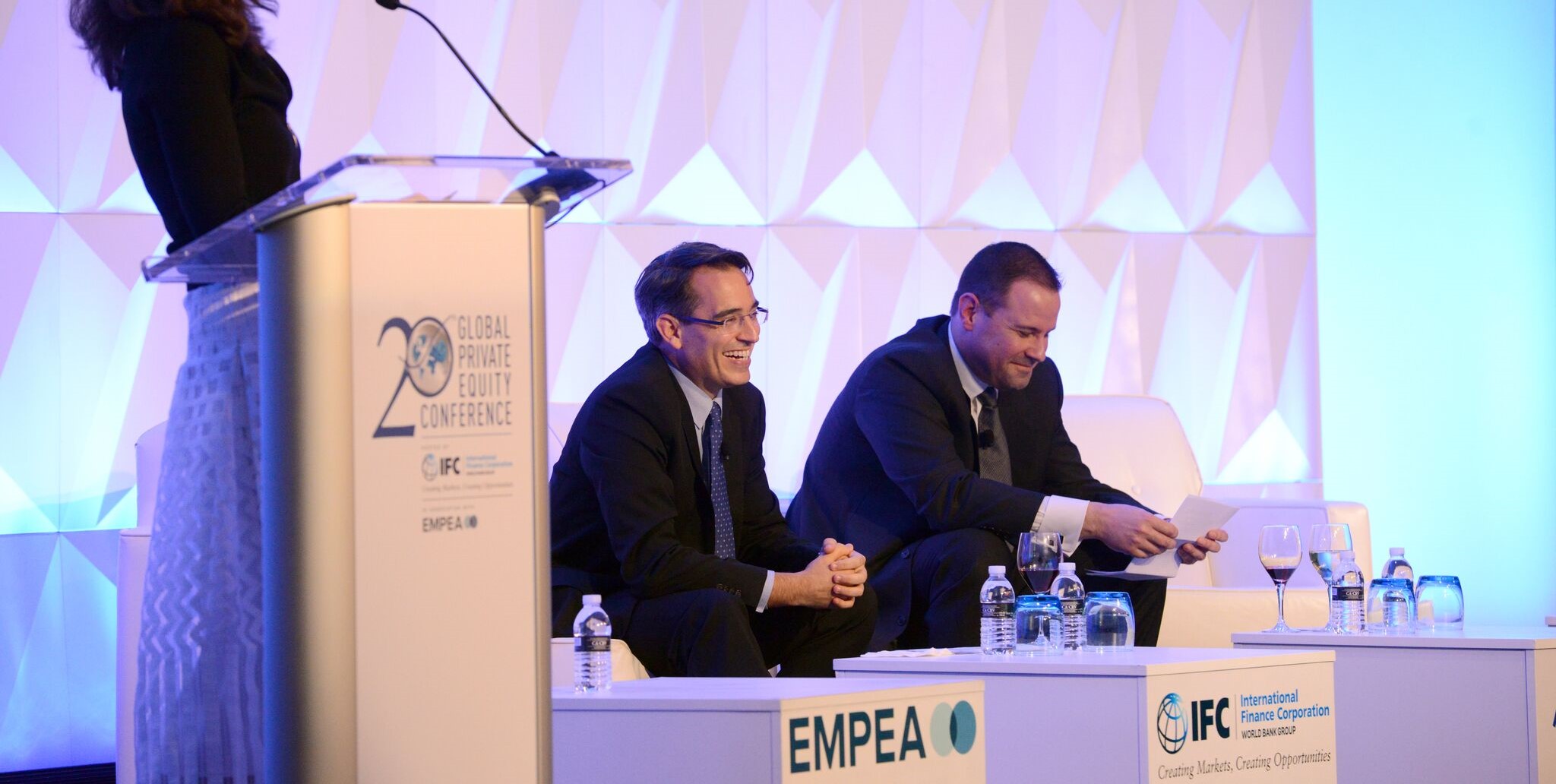
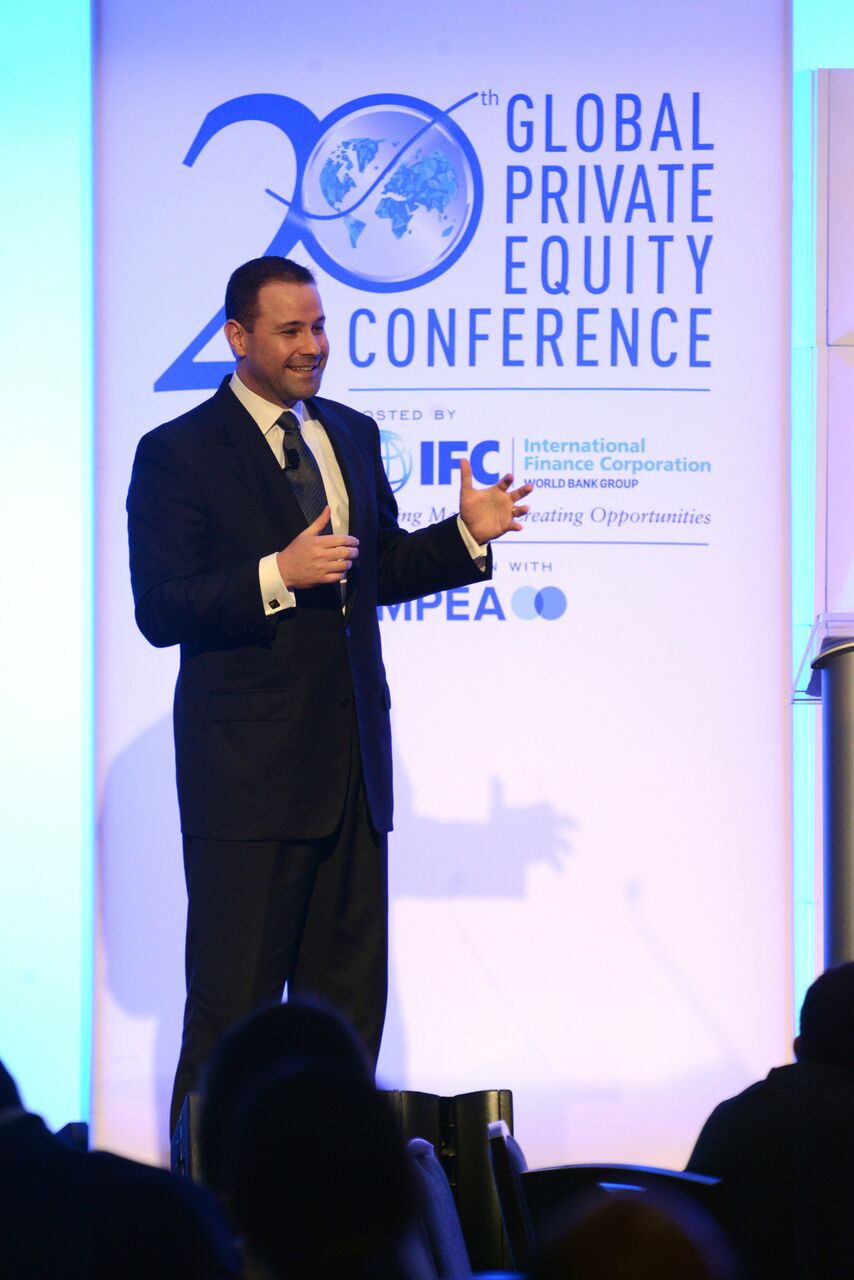
TriLinc Global Chief Investment Officer, Paul Sanford, recently participated in the Oxford-Style Debate at the International Finance Corporation’s (IFC) 20th Annual Global Private Equity Conference in association with the Emerging Markets Private Equity Association (EMPEA).

The Global Private Equity Conference (GPEC) is the leading emerging markets private equity event in the world, each year hosting over 850 investment professionals from more than 60 countries. Organizations from family offices, to fund-of-funds, to private equity managers gather for thought-provoking discussions, debates and analyses that are most top-of-mind for today’s business and industry leaders.

On May 16th, GPEC hosted an Oxford-Style Debate on the subject of Private Debt versus Private Equity. Both debaters were also impact investors; Paul Sanford argued on behalf of private debt as Chief Investment Officer at TriLinc , and his counterpart Andrew Kuper argued in favor of private equity as Founder and CEO of Leapfrog Investments. Before presenting arguments, the audience was asked to vote in favor for private equity or private debt using a voting system through a mobile phone application integrated with the event.

Mr. Kuper opened the debate with a strong position rooted in the upside potential of private equity. He challenged the audience to imagine investing in a successful emerging markets company such as Alibaba.

“If you had invested in Alibaba… do you say, ‘Oh, how I wish I had invested in their bonds or given them a little bit of credit,’? Or do you say, ‘I wish I had invested in the equity, because I’d be a billionaire!’” Andrew Kuper, Founder and CEO of Leapfrog Investments.

Mr. Sanford opened the debate with an equally strong position on private debt and asked the audience to raise their hands if they were an LP or allocator. As member of the investment committee for City of Hope, a billion-dollar cancer research facility, Mr. Sanford is himself an LP and understands that pitching private equity in emerging markets might have his committee members, “pass out” (which drew a few laughs from the audience). Identifying with a large majority of the audience, he argued that private equity alone was too risky despite the opportunity to make large returns.

“[For LPs,] Emerging Market private debt is at a minimum the best way to dip their toe into the asset class, into the region, get comfortable with private assets, see the return stream and then say, ‘Well, that was a great experience – why don’t I look at private equity?’” Paul Sanford, Chief Investment Officer of TriLinc Global.

In true Oxford style, both debaters fielded questions from the audience before the audience was asked to cast another vote. Mr. Sanford’s arguments changed enough of the audience’s votes from private equity to private debt, and he was named the victor. In good fashion, both debaters felt a combination of both private equity and private debt is the best path to success when investing in Emerging Markets.

You can watch the debate in its entirety below:

https://vimeo.com/272817056

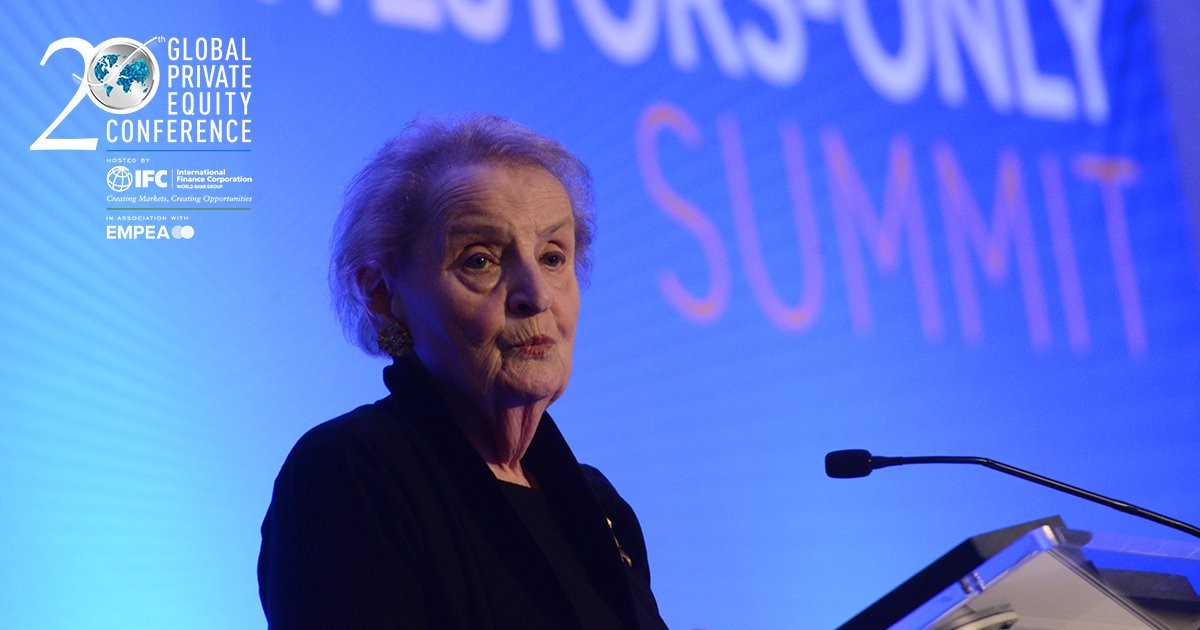
Impact Investing was an overarching theme at this year’s 20th Global Private Equity Conference. Several panels and breakout sessions focused on impact investing, Environmental, Social, and Governance (ESG) investing, and the growth of the UN’s Sustainable Development Goals (SDGs). It was Secretary Madeleine Albright’s opening statement that truly connected emerging market investing and impact investing.

“Good Emerging Market investors are all impact investors, and some of the best opportunities in Emerging Markets don’t just serve one country but many geographies,” Madeleine Albright, Secretary of State, 1997-2001.

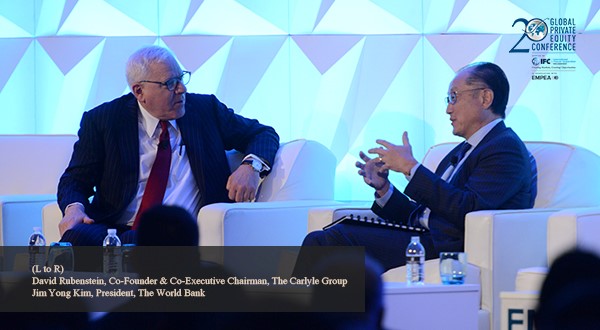
Dr. Jim Kim, President of The World Bank, spoke with David Rubenstein, Co-Founder of The Carlyle Group. Dr. Kim discussed the need to make capitalism work for everyone on the planet and suggested that private investments will play a critical role in providing the capital and expertise needed in emerging markets. Mr. Rubenstein predicted that more private capital would enter emerging markets over the next 10 years as growth trends and the economic climate in emerging markets improve.

“We have 8 billion people with middle class aspirations,” Dr. Jim Kim, President of The World Bank.

TriLinc Global would like to thank EMPEA and the IFC for continuing to advance an industry by way of organizing, educating, and inspiring so many through its Global Private Equity Conference. We’re honored to have been asked to participate in a special way this year and look forward to next year. For more information on EMPEA, visit their website: https://www.empea.org/

Joan Trant Participated in Panel on the Impact of Fixed Income at Total Impact Conference

TriLinc Global Managing Partner, Joan Trant, recently attended the Total Impact Conference and participated on a panel – Making Impact with Fixed Income.

The Total Impact Conference is a collaborative event with the Good Capital Project and ImpactPHL. The conference aims to help financial advisors and investors who are seeking to simultaneously achieve financial and social returns. Sustainable investment experts, academics, and development leaders spent two days demonstrating how to integrate impact across asset classes.

The Making Impact with Fixed Income panel focused on municipal bonds, social impact bonds, microfinance, community notes and other fixed income products in the market working to achieve social impact across the fixed income risk-return spectrum.

“ESG and impact requirements not only help mitigate governance, social and environmental risks; they help ensure execution of fiduciary duty,” said Joan Trant, Managing Partner, from the panel.

Joan Trant put forth the idea that investors and advisors can use fixed income investments to build their own impact investment portfolios.

“Fixed income investments that combine rigorous credit analysis, impact intentionality, measurement, and reporting demonstrate how investors can activate all asset classes to construct a strategic and tactical impact investment portfolio.”

TriLinc team members will be speaking at various events in the upcoming weeks. Some events include: the IFC’s 20th Annual Global Private Equity Conference in Association with EMPEA on May 16th, LPGP Connect Private Debt Conference and Women in Private Debt Conference in New York on May 22nd-23rd, the CAIA LA Impact/ESG Investing Summit on June 7th, and the IPA Women’s Initiative Network Forum on June 20th.


TriLinc Global believes in the power of collaboration and endorses key impact industry initiatives, conferences, and thought leadership that are working to build a more standardized and effective industry. TriLinc is a private impact investment fund sponsor that empowers investors to use their private capital to make positive social impact at scale, without compromising return.  By intentionally pursing investments with the potential for market-rate returns and positive measurable impact, TriLinc helps investors do well by doing good.

To learn more about our global impact, click here.

The State of Emerging Markets Webinar Replay

On December 6, 2018, Paul Sanford, Chief Investment Officer of TriLinc Global, hosted an educational webinar – The State of Emerging Markets.

The webinar covered several areas, including:

  • A look around the globe
  • Public assets vs private assets in emerging markets
  • The difference between an emerging market and a frontier market


Click here
to download a copy of the webinar deck.

porngameshub.netpornjoy.orgfistinghd.netxfaps.orgpornjav.org