The following article was published by the London School of Economics and Political Science online in the LSE Business Review. Click here to view.
Helping the common good while making money is difficult but possible, with robust methodologies to identify and seize such opportunities, write Feng Li, Gianandrea Giochetta and Luigi Mosca

Popular opinion has it that ‘investing for the common good’ has gone mainstream. Yet our research finds that only a small proportion of funds has consistently generated market rate return and measurable social and environmental impact at large scale – especially in capital-starved emerging markets’ small and medium enterprises (SMEs), often deemed as risky and unattractive by mainstream investors. With investing for return and impact, known as impact investing, only selected opportunities exist. And it takes particular leadership skills, professional expertise and organisational setup to tackle them.
What is impact investing?
The need for impact investing has arisen from the persistence of societal challenges and the inability of existing institutions to eradicate them. Yet despite growing enthusiasm for such goals, there is still no consensus on what impact investing is. This is reflected in the huge variations in the estimated size of assets under management, from $502 billion by the Global Impact Investing Network (GIIN), to $30.4 trillion by the Global Sustainable Investment Alliance. Such lack of conceptual clarity and rigour causes confusion and dampens investor expectations. GIIN defines impact investing as“investments made with the intention to generate positive, measurable social and environmental impact alongside a financial return”.
Unlike socially responsible investment (SRI) or environmental, social and governance (ESG) investing, impact investing is not just about avoiding “sin stocks”or “do-no-harm”, but also actively deploying capital to address social and environmental objectives while generating financial returns for investors. It requires intentionality: portfolio companies must proactively track, measure and report on their social and environmental impact. If successful, impact investing can unlock substantial capital from mainstream investors.
Challenges and opportunities for impact investing
We conducted extensive research of institutional investors and their portfolio companies. The result, however, has been disappointing. Most funds can deliver return or impact, but very few deliver both consistently at large scale. ‘Impact washing’ (particularly ‘green washing’) is rampant. According to Confucius, “he who chases two rabbits catches neither.” The challenge for impact investing is first to demonstrate that it is indeed possible to catch two rabbits at the same time, and then develop robust methodologies to identify and seize such opportunities.
For impact investing to scale, products must be capable of addressing a range of institutional needs, including the ability to absorb large pools of capital, adequate liquidity and robust risk management practices while generating measurable return and impact. These have traditionally been met through investment strategies targeting blue chip securities. Such an approach, however, results in channelling funds where it is harder to proactively generate impact, as bondholders and minority shareholders have limited opportunities to directly influence senior management teams of large corporations. Furthermore, blue chip securities are concentrated in mature markets, while the greatest need for impact capital is elsewhere. The IMF estimates a $700 billion unmet credit demand globally in terms of debt financing to emerging markets SMEs, a niche where every $1 invested contributes a further $13 to the local economy.
From a financial perspective, a supply-demand mismatch of this magnitude represents a significant opportunity, while from an impact point of view, it highlights the imperative of channelling more capital to where it matters the most. Nevertheless, institutional appetite for emerging market SME financing, particularly fixed income, remains marginal, associated with its reputation for high risk and low return.
“The highest calling of impact investing is to increase the amount of capital being invested in places, companies, products, and services that have significant social benefits”. However, the momentum has been gained predominantly in listed security markets through strategies such as exclusionary screening, positive screening, or active ownership. Since investors in listed securities can only achieve impact by, at best, influencing responsible behaviour through proxy voting, active ownership and shareholder activism, impact investing should focus more on private capital markets, through means such as venture capital, private equity and private debt. This is where investors encounter most challenges. Managerial guidance is urgently needed.
Is it possible to achieve return and impact at large scale?
Our research has found that successful examples of impact investing remain rare, particularly those consistently generating market-rate return and measurable impact at large scale. Over the last ten years, we engaged with a large number of institutional investors and their portfolio companies purported to deliver return and impact. Within the niche of SME lending in emerging markets, we have found only a handful of institutional players operating in the segment, and TriLinc Advisors LLC (TriLinc) stood out as an exemplar. Its flagship fund, TriLinc Global Impact Fund (“TGIF”), has made over $1 billion in loans to 82 businesses in 36 countries since 2013, delivering a consistent unlevered net annual return of seven to nine per cent to investors and measurable impact using established international standards. The experience of this case study illustrates that impact investing is indeed possible, but very difficult to do. It requires special leadership skills, professional expertise and organisational setup to identify suitable opportunities and seize them. Importantly, the success of TriLinc can be replicated.
Managerial implications
Our research shows that specialising in fixed income – which is the largest capital market – rather than other asset classes, brings a huge potential for scaling up impact investments. The case is also unique in that it focuses on emerging markets, servicing primarily undercapitalised SMEs in developing countries. The TriLinc success stems from its ability to distil a simple yet actionable strategy, structure an investment product matching institutional expectations, and execute it through an effectively configured operation. A series of managerial considerations also mattered, an area little explored in the context of impact investing.
The case demonstrated that it pays to focus on less efficient markets where greater arbitrage opportunities may be found. The specific niche covered by TriLinc is vast and there are opportunities for other players to enter this segment. A similar approach may be applied to other market niches demonstrating such characteristics.
From an impact perspective, the challenge is to identify targets that are both realistic and measurable using established international standards. Rather than pursuing complex objectives, it may be preferable to aim for goals with a high probability of success and that may be achieved over a relatively short time span.
CASE STUDY
TriLinc Global Impact Fund (TGIF): impact investing in an unloved market niche
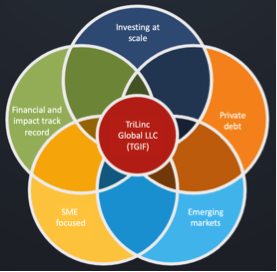
TriLinc Global Impact Fund, LLC (TGIF) is an impact-investing fund managed by California-based TriLinc Advisors, LLC (TriLinc). It was ranked 9th in the Global Banking and Finance Review’s top 100 impact companies in 2019. As of December 2018, its portfolio companies created over 18,500 jobs, achieved 100 per cent compliance with local environmental, labour, health, safety and business laws, standards and regulations, and all have committed to working towards implementing international environmental and health and safety best practices. Seventy-seven per cent of portfolio companies also demonstrated positive impact on their local communities through services or donations; and 91 per cent implemented environmentally sustainable practices (Figure 1).
Figure 1. The investment approach by TriLinc Global Impact Fund (TGIF)
We conducted extensive research on TriLinc, including multiple interviews with key members of the senior management team and exclusive access to a confidential dataset on some of its portfolio companies. Our research identified four critical factors for its success.
1. Veterans with track record in commercial investing and motivation for impact
After a long career on Wall Street, founder and CEO Gloria Nelund assembled an experienced team at TriLinc – who often described themselves as “reformed Wall Streeters”. The team are united by the vision that impact investing represents a realistic alternative only if it delivers financial return in line with or superior to traditional products. By building on their commercial experiences, they strive to align social and environmental motives with financial objectives.
2. Investment strategy engineered to maximise both return and impact
TriLinc’s strategy was engineered from the ground up to maximize both financial and impact objectives. The global impact fund focuses on short term financing to SMEs in selected emerging economies for their expansion projects. Most investments seek to generate employment growth and support local communities and sustainable growth that can be directly aligned with the business objectives. TGIF focuses on private, US dollar-denominated short-term notes such as trade finance or term loans. This allows the adoption of company-specific ESG targets based on IRIS* standard, and enhanced risk management through ad-hoc structuring and collateralisation. Short-term loans may be held to maturity, pragmatically addressing the fund’s liquidity requirements.
3. Local partner networks for opportunity identification and monitoring
TriLinc selects target countries using a proprietary macroeconomic analysis platform that takes into consideration a number of variables, including growth, stability and access. For each target country, TriLinc teams up with an institutional-class investment partner supporting through local knowledge and presence on the ground throughout the entire life cycle. No investment is made without a local partner. This approach is seen as an efficient and cost-effective way to build a global presence. TriLinc remains involved in all key decisions and activities.
4. Investment process attributing equal weighting to impact and financial considerations
All deals are appraised through an intertwined process assessing the merits from both financial and impact perspectives. A loan is only made when both sets of conditions are met. TriLinc has identified five core impact metrics, tracked by every investment across the portfolio on job creation, wage increase, increased revenue, profitability improvement and increased company taxes paid. Additionally, each portfolio company selects, and–through KPIs–is held accountable for, its own impact objectives. TriLinc can influence its portfolio companies through both “positives” and “proactive prevention of negatives”, using IRIS standard to track and report impact activities at both the fund and borrower levels.
* IRIS (Impact Reporting and Investment Standards) is an initiative of the Global Impact Investing Network (GIIN), a nonprofit organisation dedicated to increasing the scale and effectiveness of impact investing.
Notes:
- Authors’ disclaimer: The authors do not receive any financial support, nor hold any financial interest in TriLinc and its associated companies or funds.
- This blog post gives the views of its authors, not the position of LSE Business Review or the London School of Economics.
- Featured image by Soneva Foundation, under a CC-BY-NC-2.0 licence
- The statements and opinions expressed are those of the author and not necessarily those of TriLinc Global, LLC and its affiliates (collectively, “TriLinc”). It is meant for educational purposes only and should not be considered as investment advice or a recommendation of any particular security, strategy, or investment product. Certain information contained herein regarding TriLinc is based on information provided or confirmed by TriLinc while other information has been obtained from third party sources and such information has not been independently verified by TriLinc. No representation, warranty, or undertaking, expressed or implied, is given to the accuracy or completeness of such information. Past performance is not indicative of future returns.
 Feng Li is chair of information management at Cass Business School, City, University of London. His research investigates how digital technologies facilitate strategic innovation and organisational transformation in the digital economy. He has led a series of multi-million pounds (dollars) research programmes aimed at addressing grand societal challenges via financially sustainable and scalable approaches. He advises senior business leaders and policymakers on how to manage the transition to new technologies, new business models, and new organisational forms. He is a fellow of the British Academy of Management (FBAM) and the Academy of Social Sciences (FAcSS). E-mail: feng.li.1@city.ac.uk
 Gianandrea Giochetta is a senior research fellow at Cass Business School, where he focuses on impact investing and socially responsible projects. He has over 20 years of experience in corporate strategy and international capital markets, both in mature and emerging economies. He previously worked for JPMorgan, McKinsey and Booz Allen & Hamilton.
 Luigi Mosca is a research fellow at Imperial College London. His research interests lie at the intersection of organisation theory and strategy. He received his Ph.D. in economics and management from the University of Padova (Italy). Prior to joining Imperial, Luigi was a research fellow at Cass Business School.