Vulcan Capital Returns to TriLinc Global to Seed New Global Impact Offering

MANHATTAN BEACH, Calif. — (BUSINESS WIRE) — Vulcan Capital, the multi-billion dollar investment arm of Vulcan Inc. has again selected TriLinc Global Advisors, LLC (“TriLinc”) to seed the launch of its new TriLinc Global Sustainable Income Fund II, LLC (“TGSIF II”).

“Partnering with TriLinc to make investments in developing economies furthers Vulcan Capital’s mission,” said Chris Orndorff, Chief Investment Officer of Vulcan Capital. “This presents a unique opportunity for us to make a greater impact on lives and communities around the globe.”


“TriLinc could not be more pleased and honored to have Vulcan Capital partner with us again.”


“TriLinc could not be more pleased and honored to have Vulcan Capital partner with us again,” said Gloria Nelund, CEO of TriLinc Global, LLC (“TriLinc Global”). “Working together with Vulcan we can extend the impact of our investments in helping solve some of the critical global issues facing our world today.”

TGSIF II is a developing economy private debt fund focused on making private loans to private growth stage companies that are committed to responsible, sustainable management, and to the creation of positive measurable impact in their communities. “We are very pleased to continue to offer investors with what we believe to be lower risk access to private investment opportunities available in select-high growth economies including Latin America, Southeast Asia, Sub-Saharan Africa, and Emerging Europe,” commented Ms. Nelund.


About TriLinc Global, LLC
 

TriLinc Global is an impact investing fund sponsor with a mission to link market-rate returns, positive impact, and scalable solutions. Through its registered investment advisor subsidiaries, TriLinc Global has invested over $1 billion in private debt globally and seeks to demonstrate the power of the capital markets in helping solves some of the world’s pressing socioeconomic and environmental challenges. TriLinc Global funds provide growth-stage loans and trade finance to established and small and medium enterprises (“SMEs”) in select developing economies where access to affordable capital is limited. Borrower companies must demonstrate the ability to pay market rates, pass TriLinc Global’s environmental, social, and governance (ESG) screens, and commit to tracking and reporting on self-identified impact metrics. To learn more about TriLinc Global, please visit the TriLinc Global website at www.trilincglobal.com.


About Vulcan Capital
 

Vulcan Capital is the private investment arm of Vulcan Inc., the company founded by Paul G. Allen in 1986 to manage his business and philanthropic initiatives. Vulcan Capital is focused on generating long-term value appreciation across a multibillion dollar portfolio, which spans diverse industry sectors and investment asset classes, ranging from early-stage venture investments to public equity value investing, leveraged buyouts, acquisitions, and distressed situations.


Contacts
 

Robert Kronman – Director of Marketing
rkronman@trilincglobal.com 
(o) 424 200 6202
(c) 310 497 2116


DISCLAIMER

This information is for general purposes only and does not represent a recommendation or offer of any particular security, strategy, or investment. Amount invested represents current amount financed in term loans, trade finance, and short-term notes since 2013. There is no guarantee that TriLinc’s investment strategy will be successful or will avoid losses. Investment in a pooled investment vehicle involves significant risk including but not limited to: units are restricted; no secondary markets; limitation on liquidity; transfer and redemption of units’ distribution made may not come from income and if so will reduce the returns; are not guaranteed and are subject to board discretion. TriLinc Global is dependent upon its advisors and investment partners to select investments and conduct operations. TriLinc Global is not suitable for all investors. TriLinc Global, LLC (“TLG”) is a holding company and an impact fund sponsor founded in 2008. TriLinc Advisors, LLC (“TLA”) is a majority-owned subsidiary of TLG, and TriLinc Global Advisors, LLC (“TLGA”) is a wholly owned subsidiary of TLG. TLA and TLGA are SEC registered investment advisors. Securities offered through Frontier Securities LLC, Member FINRA/SIPC. Registration and memberships do not indicate a certain level of skill, training, or endorsement by the SEC, FINRA or SIPC.


TriLinc Global Ranks in Top 10 of Inaugural ‘100 Top Impact Companies’ of 2019

Published: Apr 25, 2019 1:28 p.m. ET

MANHATTAN BEACH, Calif.–(BUSINESS WIRE)–TriLinc Global, LLC (“TriLinc”) has been selected as one of the “Real Leaders Top 100 Impact Companies” of 2019.


This list, in its inaugural year, was developed in collaboration by Real Leaders, Big Path Capital, B Lab, Bain Capital, KPMG, and Mintz Levin to show that business can thrive as a force for good and rank the positive impact of companies that are leveraging the engine of capitalism for the greater good. TriLinc ranked 9th out of the 100 companies listed. Applicants were evaluated based on social and environmental impact and ranked using The B Lab assessment metrics as well as growth rate and scale. Applicants were required to provide verification of growth and practices.


“We are very honored to be included on this list and to be recognized for our mission to harness the power of the capital markets in helping to solve global challenges facing our society,” said Gloria Nelund, CEO of TriLinc. “TriLinc is excited to be working alongside impact industry peers to move impact investing further into the mainstream,” stated Gloria.


TriLinc, through its registered investment advisers, pursues an impact investing strategy that provides growth-stage loans and trade finance to established small and medium enterprises (“SMEs”) in developing economies where access to affordable capital is significantly limited. Impact investing is defined as investing with the specific objective of achieving a competitive financial return as well as creating positive, measurable impact in communities across the globe.


DISCLAIMER

The REAL LEADERS 100 List was created using the ranking formula of Revenue x Growth Rate x B Impact Assessment = Force for Good. The B Impact Assessment metric was chosen as an industry third-party assessment tool as B Lab oversees the B corp certification process. Growth rate represents economic growth. TriLinc submitted an application for consideration for ranking which did not include any fees or payments. TriLinc’s receipt of this recognition is in no way indicative of any individual client or investor’s experience with TriLinc, TLA, or TLGA, or of past or future investment performance.

This information is for general purposes only and does not represent a recommendation or offer of any particular security, strategy, or investment. There is no guarantee that TriLinc’s investment strategy will be successful or will avoid losses. Investment in a pooled investment vehicle involves significant risk including but not limited to: units are restricted; no secondary markets; limitation on liquidity; transfer and redemption of units’ distribution made may not come from income and if so will reduce the returns; are not guaranteed and are subject to board discretion. TriLinc is dependent upon its advisors and investment partners to select investments and conduct operations. TriLinc is not suitable for all investors. TriLinc Global LLC (“TLG”) is a holding company and an impact fund sponsor founded in 2008. TriLinc Advisors, LLC (“TLA”) is a majority-owned subsidiary of TLG and TriLinc Global Advisors LLC. (“TLGA”) is a wholly-owned subsidiary of TLG. TLA and TLGA are SEC registered investment advisors. Securities offered through Frontier Securities LLC, Member FINRA/SIPC. Registration and memberships do not indicate a certain level of skill, training or endorsement by the SEC, FINRA or SIPC.


CONTACTS

TriLinc Global, LLC
Robert Kronman, Director of Marketing
(o) 424 200 6202
(c) 310 497 2117
rkronman@trilincglobal.com

TriLinc Global Launches New Fund

February 06, 2019 10:15 AM Pacific Standard Time

MANHATTAN BEACH, Calif.–(BUSINESS WIRE)–TriLinc Global, LLC announced today its Regulation D offering of the TriLinc Global Impact Fund II, LLC. “We are very pleased to continue to offer investors with what we believe to be lower risk access to private investment opportunities available in select-high growth economies including Latin America, Southeast Asia, Sub-Saharan Africa, and Emerging Europe,” commented Gloria Nelund, CEO of TriLinc Global, LLC. The TriLinc Global Impact Fund II, LLC (“TGIF II”) is a developing economy private debt fund focused on making private loans to private growth stage companies that are committed to responsible, sustainable management and to the creation of positive, measurable impact in their communities. “We believe this shortage of capital helps create meaningful opportunity to generate competitive risk-adjusted returns and positive impact,” stated Ms. Nelund.


About TriLinc Global, LLC

TriLinc Global (www.trilincglobal.com)

TriLinc is an impact investing fund sponsor with a mission to link market-rate returns, positive impact, and scalable solutions. Through its registered investment advisor subsidiaries, TriLinc has invested over $1 billion in private debt globally and seeks to demonstrate the power of the capital markets in helping solve some of the world’s pressing socioeconomic and environmental challenges. TriLinc funds provide growth-stage loans and trade finance to established small and medium enterprises (“SMEs”) in select developing economies where access to affordable capital is limited. Borrower companies must demonstrate the ability to pay market rates, pass TriLinc’s environmental, social, and governance (ESG) screens, and commit to tracking and reporting on self-identified impact metrics. To learn more about TriLinc Global please visit the TriLinc Global website at www.trilincglobal.com.


DISCLAIMER

This information is for general purposes only and does not represent a recommendation or offer of any particular security, strategy, or investment. Amount invested represents current amount financed in term loans, trade finance, and short-term notes since 2013. There is no guarantee that TriLinc’s investment strategy will be successful or will avoid losses. Investment in a pooled investment vehicle involves significant risk including but not limited to: units are restricted; no secondary markets; limitation on liquidity; transfer and redemption of units’ distribution made may not come from income and if so will reduce the returns; are not guaranteed and are subject to board discretion. TriLinc is dependent upon its advisors and investment partners to select investments and conduct operations. TriLinc is not suitable for all investors. TriLinc Global LLC (“TLG”) is a holding company and an impact fund sponsor founded in 2008. TriLinc Advisors, LLC (“TLA”) is a majority-owned subsidiary of TLG and TriLinc Global Advisors LLC. (“TLGA”) is a wholly-owned subsidiary of TLG. TLA and TLGA are SEC registered investment advisors. Securities offered through Frontier Securities LLC, Member FINRA/SIPC. Registration and memberships do not indicate a certain level of skill, training or endorsement by the SEC, FINRA or SIPC.

Contacts

Robert Kronman – Director of Marketing
rkronman@trilincglobal.com
(o) 424 200 6202
(c) 310 497 2116

TGSIF Fund Closing Notice

On December 31, 2018, the TriLinc Global Sustainable Income Fund (“TGSIF”) closed the offering period to investors.

TriLinc plans to launch new funds in Q1 2019 in order to continue to provide investors with what we believe to be lower risk access to private investment opportunities available in select high-growth economies including Latin America, Southeast Asia, Sub-Saharan Africa, and Emerging Europe.

TriLinc’s private debt investment strategy (Private Debt Plus®) aims to deliver market-rate returns through private loans to private Small and Medium-sized Enterprises (SMEs) in select developing countries plus positive impact that is measurable and reportable utilizing the Global Impact Investing Network (GIIN) Impact Reporting and Investment Standards (IRIS).

For additional information, please contact info@trilincglobal.com


DISCLAIMER

This information is for general purposes only and does not represent a recommendation or offer of any particular security, strategy, or investment. There is no guarantee that TriLinc’s investment strategy will be successful or will avoid losses. Investment in a pooled investment vehicle involves significant risk including but not limited to: units are restricted; no secondary markets; limitation on liquidity; transfer and redemption of units’ distribution made may not come from income and if so will reduce the returns; are not guaranteed and are subject to board discretion. TriLinc is dependent upon its advisors and investment partners to select investments and conduct operations. TriLinc is not suitable for all investors. TriLinc Global LLC (“TLG”) is a holding company and an impact fund sponsor founded in 2008. TriLinc Advisors, LLC (“TLA”) is a majority-owned subsidiary of TLG and TriLinc Global Advisors LLC. (“TLGA”) is a wholly-owned subsidiary of TLG. TLG and TLGA are SEC registered investment advisors. Securities offered through Frontier Securities LLC, Member FINRA/SIPC. Registration and memberships do not indicate a certain level of skill, training or endorsement by the SEC, FINRA or SIPC.

TriLinc Takes Center Stage at EMPEA Conference

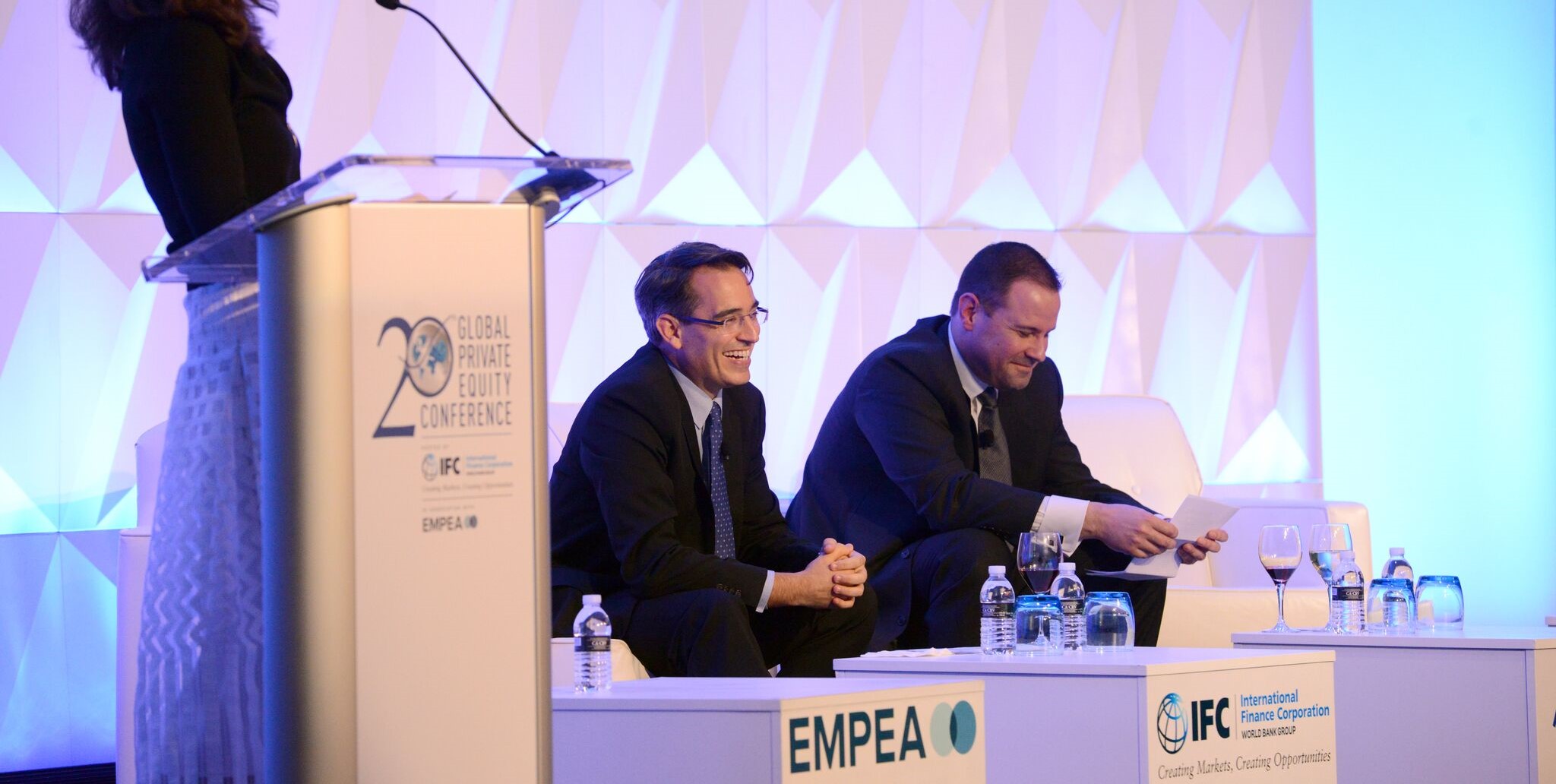
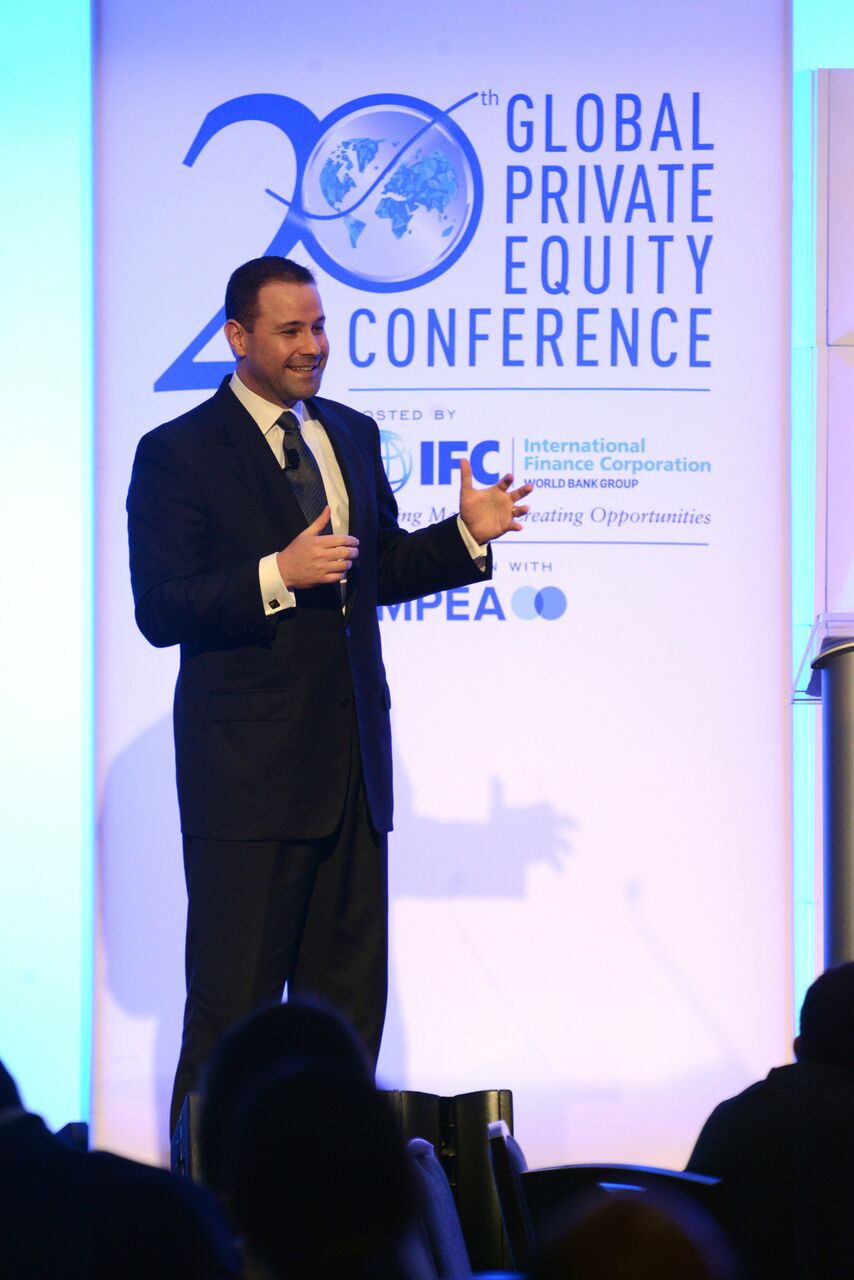
TriLinc Global Chief Investment Officer, Paul Sanford, recently participated in the Oxford-Style Debate at the International Finance Corporation’s (IFC) 20th Annual Global Private Equity Conference in association with the Emerging Markets Private Equity Association (EMPEA).

The Global Private Equity Conference (GPEC) is the leading emerging markets private equity event in the world, each year hosting over 850 investment professionals from more than 60 countries. Organizations from family offices, to fund-of-funds, to private equity managers gather for thought-provoking discussions, debates and analyses that are most top-of-mind for today’s business and industry leaders.

On May 16th, GPEC hosted an Oxford-Style Debate on the subject of Private Debt versus Private Equity. Both debaters were also impact investors; Paul Sanford argued on behalf of private debt as Chief Investment Officer at TriLinc , and his counterpart Andrew Kuper argued in favor of private equity as Founder and CEO of Leapfrog Investments. Before presenting arguments, the audience was asked to vote in favor for private equity or private debt using a voting system through a mobile phone application integrated with the event.

Mr. Kuper opened the debate with a strong position rooted in the upside potential of private equity. He challenged the audience to imagine investing in a successful emerging markets company such as Alibaba.

“If you had invested in Alibaba… do you say, ‘Oh, how I wish I had invested in their bonds or given them a little bit of credit,’? Or do you say, ‘I wish I had invested in the equity, because I’d be a billionaire!’” Andrew Kuper, Founder and CEO of Leapfrog Investments.

Mr. Sanford opened the debate with an equally strong position on private debt and asked the audience to raise their hands if they were an LP or allocator. As member of the investment committee for City of Hope, a billion-dollar cancer research facility, Mr. Sanford is himself an LP and understands that pitching private equity in emerging markets might have his committee members, “pass out” (which drew a few laughs from the audience). Identifying with a large majority of the audience, he argued that private equity alone was too risky despite the opportunity to make large returns.

“[For LPs,] Emerging Market private debt is at a minimum the best way to dip their toe into the asset class, into the region, get comfortable with private assets, see the return stream and then say, ‘Well, that was a great experience – why don’t I look at private equity?’” Paul Sanford, Chief Investment Officer of TriLinc Global.

In true Oxford style, both debaters fielded questions from the audience before the audience was asked to cast another vote. Mr. Sanford’s arguments changed enough of the audience’s votes from private equity to private debt, and he was named the victor. In good fashion, both debaters felt a combination of both private equity and private debt is the best path to success when investing in Emerging Markets.

You can watch the debate in its entirety below:

https://vimeo.com/272817056

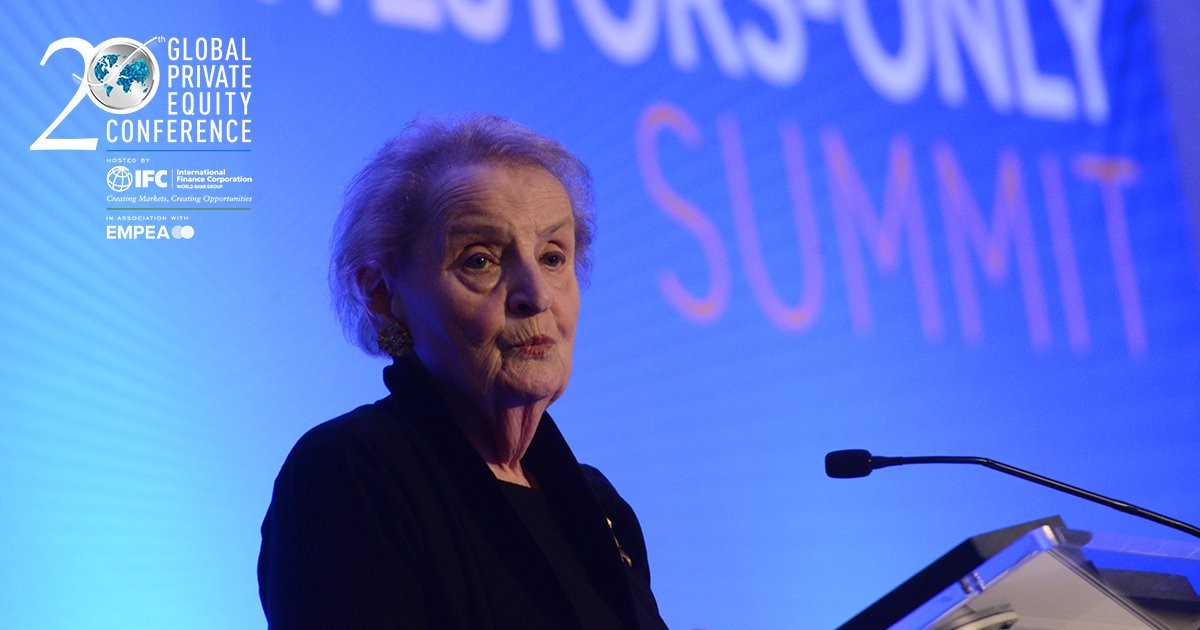
Impact Investing was an overarching theme at this year’s 20th Global Private Equity Conference. Several panels and breakout sessions focused on impact investing, Environmental, Social, and Governance (ESG) investing, and the growth of the UN’s Sustainable Development Goals (SDGs). It was Secretary Madeleine Albright’s opening statement that truly connected emerging market investing and impact investing.

“Good Emerging Market investors are all impact investors, and some of the best opportunities in Emerging Markets don’t just serve one country but many geographies,” Madeleine Albright, Secretary of State, 1997-2001.

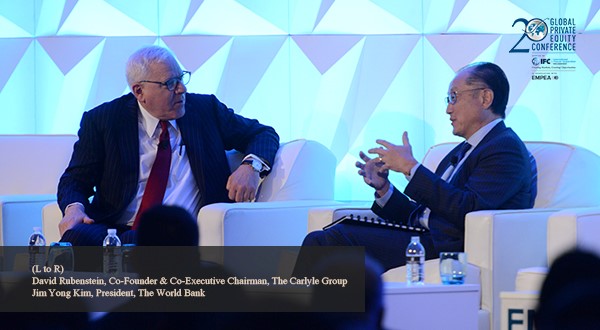
Dr. Jim Kim, President of The World Bank, spoke with David Rubenstein, Co-Founder of The Carlyle Group. Dr. Kim discussed the need to make capitalism work for everyone on the planet and suggested that private investments will play a critical role in providing the capital and expertise needed in emerging markets. Mr. Rubenstein predicted that more private capital would enter emerging markets over the next 10 years as growth trends and the economic climate in emerging markets improve.

“We have 8 billion people with middle class aspirations,” Dr. Jim Kim, President of The World Bank.

TriLinc Global would like to thank EMPEA and the IFC for continuing to advance an industry by way of organizing, educating, and inspiring so many through its Global Private Equity Conference. We’re honored to have been asked to participate in a special way this year and look forward to next year. For more information on EMPEA, visit their website: https://www.empea.org/

Joan Trant Participated in Panel on the Impact of Fixed Income at Total Impact Conference

TriLinc Global Managing Partner, Joan Trant, recently attended the Total Impact Conference and participated on a panel – Making Impact with Fixed Income.

The Total Impact Conference is a collaborative event with the Good Capital Project and ImpactPHL. The conference aims to help financial advisors and investors who are seeking to simultaneously achieve financial and social returns. Sustainable investment experts, academics, and development leaders spent two days demonstrating how to integrate impact across asset classes.

The Making Impact with Fixed Income panel focused on municipal bonds, social impact bonds, microfinance, community notes and other fixed income products in the market working to achieve social impact across the fixed income risk-return spectrum.

“ESG and impact requirements not only help mitigate governance, social and environmental risks; they help ensure execution of fiduciary duty,” said Joan Trant, Managing Partner, from the panel.

Joan Trant put forth the idea that investors and advisors can use fixed income investments to build their own impact investment portfolios.

“Fixed income investments that combine rigorous credit analysis, impact intentionality, measurement, and reporting demonstrate how investors can activate all asset classes to construct a strategic and tactical impact investment portfolio.”

TriLinc team members will be speaking at various events in the upcoming weeks. Some events include: the IFC’s 20th Annual Global Private Equity Conference in Association with EMPEA on May 16th, LPGP Connect Private Debt Conference and Women in Private Debt Conference in New York on May 22nd-23rd, the CAIA LA Impact/ESG Investing Summit on June 7th, and the IPA Women’s Initiative Network Forum on June 20th.


TriLinc Global believes in the power of collaboration and endorses key impact industry initiatives, conferences, and thought leadership that are working to build a more standardized and effective industry. TriLinc is a private impact investment fund sponsor that empowers investors to use their private capital to make positive social impact at scale, without compromising return.  By intentionally pursing investments with the potential for market-rate returns and positive measurable impact, TriLinc helps investors do well by doing good.

To learn more about our global impact, click here.

Vulcan Capital Provides Seed to TriLinc for Global Impact Investments

LOS ANGELES – (BUSINESS WIRE) — Vulcan Capital, the multi-billion dollar investment arm of Vulcan Inc., has selected TriLinc Global Advisors (“TriLinc”) to seed the launch of the TriLinc Global Sustainable Income Fund (“TGSIF”). The investment is part of Vulcan Capital’s impact investing strategy.

Impact Investing is defined as investing with the specific objective to achieve a competitive financial return as well as creating positive, measurable impact in communities across the globe. 

TriLinc Global is an innovative impact investing fund sponsor with a mission to link market-rate returns, positive impact, and scalable solutions. Through its registered investment advisor subsidiaries, TriLinc has invested over $700 million in private debt globally and seeks to demonstrate the power of the capital markets in helping to solve some of the world’s pressing socioeconomic and environmental challenges. TriLinc funds provide growth-stage loans and trade finance to established small and medium enterprises (“SMEs”) in select developing economies where access to affordable capital is significantly limited. Borrower companies must demonstrate the ability to pay market rates, pass TriLinc’s environmental, social and governance (ESG) screens, and commit to tracking and reporting on self-identified impact metrics. 


“We believe that if something has the potential to do good, then we should do it.”


Founded by Microsoft co-founder and philanthropist Paul G. Allen, Vulcan Capital invests across all stages of corporate development including venture capital, growth equity and leveraged buyouts as well as investing in public equities and other liquid asset classes. Vulcan Capital’s current portfolio spans a range of industry sectors, including technology, internet, mobile, life sciences, energy, and natural resources, media and communications, and financial and information services. 

“Vulcan Capital is excited to be partnered with TriLinc Global in such a values aligned investment opportunity,” said Chris Orndorff, Chief Investment Officer of Vulcan Capital. “Vulcan strives to be at the cutting edge of impact investing, and we are proud to be partnered with TriLinc.” 

“TriLinc Global is honored to be partnering with Vulcan Capital,” said Gloria Nelund, Chairman and CEO of TriLinc Global, LLC. “Like Paul Allen and Vulcan, we believe that if something has the potential to do good, then we should do it, so we are thrilled to be working together with them to extend the impact of our investments in helping to solve some of the critical global issues facing our world today.”


About TriLinc Global, LLC

TriLinc Global is a private investment fund sponsor that empowers investors to use their private capital to make positive social impact at scale, without compromising return.  Through its registered investment advisor subsidiaries, TriLinc Advisors, LLC and TriLinc Global Advisors, LLC, TriLinc offers investors alternative investment products that pursue unique yield-oriented strategies while fostering the view that capitalism can be a force for good.  TriLinc believes in the power of the capital markets to solve social and environmental challenges and was founded on the conviction that impact investing not only rewards investors with attractive returns, it also has the power to change our world for the better.  For more information, please visit www.trilincglobal.com.


About Vulcan Capital

Vulcan Capital is the private investment arm of Vulcan Inc., the company founded by Paul G. Allen in 1986 to manage his business and philanthropic initiatives. Vulcan Capital is focused on generating long-term value appreciation across a multibillion dollar portfolio, which spans diverse industry sectors and investment asset classes, ranging from early-stage venture investments to public equity value investing, leveraged buyouts, acquisitions, and distressed situations.  


Contacts

TriLinc Global, LLC
Gloria Nelund, 310-220-0871
Chief Executive Officer 

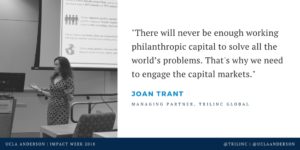
Joan Trant, Managing Partner, Kicks Off UCLA Impact Week 2018

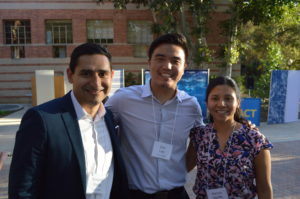
On April 9th, TriLinc Global Managing Partner, Joan Trant, kicked off Impact Week at UCLA Anderson School of Management with a fireside chat and engaging Q&A with students and program graduates. Joan covered topics on impact investing, Environmental, Social, and Governance (ESG), and impact measurement. TriLinc team members also participated in Networking Night following the fireside chat.

Impact Week is a collaboration between Impact@Anderson and the UCLA Anderson Net Impact Chapter. This year featured thought leaders and founders of mission-driven businesses and their powerful insights in the form of design workshops, panels, screenings, network mixers and more. ULCA Impact Week is a unique student-led event focused on finding the intersection of purpose and profit. Participating organizations included TriLinc Global, Patagonia, Morgan Stanley, BuzzFeed, Google, OpenIDEO, California Community Foundation, Sagewise, and CalSTRS.


Joan spoke about her career path first in international financial services in the Spanish, Mexican, and Argentine markets, and how that led to nonprofit development work in Latin America, then to global microfinance investment, and eventually to small and medium enterprise investment, given the sector’s catalytic effects on job creation and economic development.

“The world is an exciting, adventurous place where we all want the same things for ourselves and our families, but we don’t all have the same opportunities. TriLinc harnesses the power of capital markets to create the kind of world we want to live in.”

She also addressed the combined role of philanthropy and investment.

 “There will never be enough working philanthropic capital to solve all the world’s problems. That’s why we need to engage the capital markets.”


TriLinc Global is a private investment fund sponsor that empowers investors to use their private capital to make positive social impact at scale, without compromising return.  By intentionally pursing investments with the potential for market-rate returns and positive measurable impact, TriLinc helps investors do well by doing good.

To learn more about our global impact, click here.

The Global Impact Investing Network (GIIN) Presents: #GIINRoadmap

The Global Impact Investing Network (GIIN) released its Roadmap for the Future of Impact Investing: Reshaping Financial Markets. Commenced at the ten-year anniversary of the coining of the term impact investing, the Roadmap assesses industry progress to date, presents a vision for the financial markets, and outlines 18 specific actions needed to exponentially enhance the scale and effectiveness of impact investing across the world. The GIIN is the leading organization dedicated to increasing the scale and effectiveness of impact investing as well as transparency, credibility, and consistency in impact performance reporting.


TriLinc Global, LLC (“TriLinc”) is a founding member of the GIIN and actively supports the GIIN’s efforts to unlock significant private investment capital to help solve pressing global challenges.


“TriLinc is a founding member of the GIIN, and we have always shared the vision and dedication to improve the world through investing,” said Gloria Nelund, Founder and CEO at TriLinc Global, LLC. “Our management team are former senior executives of global banks and investment firms, with significant experience in impact investing. We are committed to contributing thought capital, as well as to providing investors with access to products that pursue market-rate returns alongside meaningful socioeconomic and environment impact.”

The Roadmap was developed with inputs from 350 individuals, including TriLinc’s Managing Partner, Joan Trant, who participated in the Senior-level Consultation to identify and refine the bold actions needed to integrate the broader financial markets into impact investing to achieve a better form of capitalism.

 “As a fund sponsor, at TriLinc it is our goal to harness the power of the capital markets to make a difference in communities across the globe,” said Joan Trant, Managing Partner at TriLinc . “We believe the pursuit of meaningful financial return and positive social and economic impact are mutually reinforcing, and industry research increasingly supports our position that a disciplined investment process that incorporates environmental, social, and governance screening and impact metrics can enhance risk-adjusted returns through identifying and mitigating potential risks.”

Learn more about this ambitious vision for transforming financial markets to create a world where social and environmental impact are routinely integrated into investment decisions. Find out how we can collectively take action to attain this vision here: https://roadmap.thegiin.org/

For more information about TriLinc’s impact investing philosophy, visit https://www.trilincglobal.com/impact/our-philosophy/. TriLinc Global is a founding member of the GIIN and its registered investment adviser subsidiaries actively use the GIIN’s Impact Reporting & Investment Standards (IRIS) to measure investments’ social, environmental, and financial performance. For more information about our reporting standards, visit https://www.trilincglobal.com/impact/reporting-standards/.

View TriLinc’s 2017 Sustainability and Impact Report here.


Gloria Nelund featured on Impact Mania

Original Article on Impact Mania


Gloria Nelund, Chairman & CEO of TriLinc Global, on Impact Investment

BY PAKSY PLACKIS-CHENG

Gloria Nelund cofounded TriLinc Global after serving as CEO of the U.S. Private Wealth Management Division at Deutsche Bank. TriLinc is set out to prove that profit and purpose go hand in hand.

Nelund retired at 44 and went into her “wilderness journey.” At one point she was a volunteer teacher for at-risk youth in the Los Angeles Unified School District. She spoke with impactmania about how one person, a man like her father, can impact thousands of people and how she decided to be in finance as a source of good.


How do you respond to market perception, where even professional investors are looking at impact investments and saying that they generate no or low financial returns?

It’s one of the reasons I started TriLinc Global. It was to prove to investors that they don’t have to give up the investment return to do good. If an impact investment is a real investment, then investment managers should be following the same investment discipline that they would for any investment in that asset class.

We believe that there are a number of funds that are impact funds that are probably not market rate. They focus more on promoting the impact. But we know there are a number of funds, including our own, that generate both a market rate return and positive impact. They’re not mutually exclusive, or they don’t need to be.

One of the things that we tried to do in the industry is work with other firms … to help define and promote the idea that investment discipline is just as important as measuring and monitoring and reporting the impact.

Could you provide an example of how you measure non-financial returns?

We ask all of our borrower companies to identify the impact that they intend to have. One of the requirements for getting money from us is that you have to be a good financial investment, and meet our investment criteria.

The second is that you have to be a sustainable company. They have to meet our environmental, social, and government screens, which really speaks more to the policies and practices of the company — how they run their company.

Then, third, we require them to have intent to create a positive measurable impact in their community. We let them self-identify what that impact is. Agriculture productivity is a positive impact that a company can have.

There are IRIS metrics [designed to measure the social, environmental, and financial performance of an investment] associated with agriculture productivity.

Once they’ve told us, for example, “We’d like to improve the energy efficiency of the farming practice,” then we go in and do a baseline assessment to say, “Okay, where are you today?”

Then we reassess. We then track, measure, monitor, and report out that impact to investors. We hold them accountable to achieving positive impact.


Are there certain industries that are better suited for impact than others?

We have seen impact across the board. We believe that any company, regardless of what they do, can have a positive impact in their community. It’s really more about their intent, and their ability to achieve that impact. The company doesn’t necessarily have to have a social mission to achieve great positive impact in a community.

We have a mine-remediation company in South Africa. Mine remediation itself may not be impactful. Their business model is that they’ll buy the land and they actually get the tailings; let’s say it’s precious metal. There are leftovers that aren’t worth mining, piles of dirt that have these things called tailings in them. This company has a process for extracting those tailings. Then they sell the tailings.

When they get through extracting all of the tailings, which is also cleaning up the land, they remediate the land, and in this case, they are donating it actually to a group that is going to build low-income houses.

Investors often say, “When I invest, I need to focus on maximizing financial returns. If I want to do good, I’ll just write a check and I’ll make a donation.” What is your response to that?

It’s interesting because I hear that all the time. Even when I was running Deutsche Bank’s Special Loans Management Department, it was surprising to me how even wealthy people separate those two thoughts in their mind. Basically everybody has two buckets. They have their investment bucket and their philanthropy bucket. Anything that they believe is concessionary — I’m not going to get the market return for that asset class — goes in their philanthropy bucket. It is very bifurcated.

High-net-worth investors typically with their whole portfolio are trying to maintain their lifestyle. Whereas retail investors in the U.S., they just want to make sure they don’t outlive their money. They can’t afford to lose any money.

A retail investor’s perspective is going to be even stronger as it relates to impact because if they believe that it’s concessionary, they can’t afford to do it. They really can’t afford to give up investment return. They might outlive their money. Retail investors typically haven’t had the opportunity, until recently.

With the trillions of dollars changing hands from one generation to another, are you seeing the next generation investing it more wisely?

This next generation of investors, because they really do care about changing the world, will get more behind it: number one because they care, but two, if we can really prove that there isn’t a trade off…

I sincerely believe that you don’t have to give up investment return to do it. Impact investments should target achieving a market return.

Our goal is to have more companies like ours who believe that it’s all about accountability and transparency and having the same discipline on the impact side that you have on the investment side. We hope to drive the industry towards that objective.

We believe we can get more people behind it even now.

You retired at age 44 from serving as the CEO of the Private Wealth Management Division at Deutsche Bank. Then you went into a couple of years of what you call “wilderness journey.” What advice do you have for people in this phase?

Take the time to experience that journey, find out what your calling is and what’s really important.

For me, through that journey, I realized that this really was my calling, It’s what I love and was really good at doing. It was about adapting the career that I loved in a way that also allowed me to have a positive impact.

I was personally missing that self-fulfillment of being, having some positive impact in the world and doing something good.

I went to volunteer for a number of organizations and realized, “Wow, this is not for me.” I so much more appreciated the people who do those things. I also realized it was harder on them having me there. I have passion about solving the problem. But I realized my contribution was supposed to come differently.

What did you learn from being a volunteer teacher of at-risk youth at the Los Angeles Unified School District?

Wow, I would say the biggest “aha!” came for me when I [realized] that we all can relate to each other on a very personal and emotional level, if we truly allow ourselves to be vulnerable and look for ways that we can relate as opposed to looking at how we’re different.

I probably learned as much in those years teaching these kids as I could have ever taught them. They have lives that none of us could even imagine. Yet they still need the same thought processes, problem-solving skills, encouragement, and ability to know how to act outside of their situation. They still need all that same stuff — or they’ll always be in it.

It was amazing; they’re just amazing people.

Who is one of your favorite impact makers — someone who left an imprint on your professional DNA?

Probably the person who got me really thinking a different way was Muhammad Yunus [a Bangladeshi social entrepreneur and banker who was awarded the Nobel Peace Prize for pioneering the concepts of microcredit and microfinance]. I got involved in microfinance, as it was getting a lot of notoriety back in the late ’90s. Yunus talked about using business as a force for good. … He spoke of people wanting to … take responsibility for their lives.

It all just made so much sense to me. I applied it differently. I didn’t do it in the microfinance space. It certainly was one of those things that got me thinking differently; realizing that you could use capitalism to solve problems, not just to make money.

Was it something you read, or did Yunus speak somewhere?

When I was at Deutsche Bank, he came and spoke to us. Deutsche Bank was very involved, early on at least, in our foundation. … It’s the first time I ever heard about microfinance really.

And directly from Yunus — that’s great.

Exactly. Then, I started researching it on my own. The Women’s World Banking Group did some events. Eventually, I was able to see it more in practice.

And then, this really did help shape me, even TriLinc: My father [Mac McMonagle] was a small businessman as I was growing up in my career. He started a number of businesses and grew them very successfully. I didn’t realize it until much later in my life that — watching my father and how he grew his businesses and how he treated employees, community members, suppliers, and customers — everybody was part of our family, and he was very ethical. When he would have a success, he would do something to give back to the community. As a result, whenever he started a new business, everybody supported him.

It was interesting because there was a time in my career when I was investing and I looked at it and was like, “Well of course; companies that do good things ultimately are going to perform better.”

Watching my dad and how he treated people certainly had a big impact on what I viewed as possible. It has shaped what we do at TriLinc.

He was a great person. He passed away a couple years ago; even then it was evident that just one person can have such an impact. We had thousands of people at the funeral.

What is one word that would describe your journey so far?

Let me think about that… interesting…

That’s the word?

That’s the word. It’s funny because the first word that came to mind was fun. I was surprised that that came to mind. I would say the majority of the time it’s fun.

I’ll take it: fun with some interesting in between.

Yes, fun with interesting in between. [Laughs.]


Prior to co-founding TriLinc, Gloria Nelund held fiduciary responsibility for more than $50 billion in investment assets. In addition to her role as divisional CEO, she served as the only female member of the Global Private Wealth Management Executive Committee.

Melissa Walker interviewed Monica Yunus. The daughter of Nobel Peace Prize winner Muhammad Yunus, one of Gloria Nelund’s impact makers.